The Frogs Have More Fun...

Flowers


"All the names I know from nurse:
Gardener's garters, Shepherd's purse,
Bachelor's buttons, Lady's smock,
And the Lady Hollyhock.

Fairy places, Fairy things,
Fairy woods where the wild bee wings,
Tiny trees for tiny dames.
- These must all be Fairy names !"

(from Child's Garden of Verses
by R.L. Stevenson)


"Anyone can write a short-story.
A bad one, I mean."

(R.L. Stevenson)
----------------

"Science without conscience is the Soul's perdition."
- Francois Rabelais, Pantagruel
- Acc to/above is citated from: Medical Apartheid. The dark history of Medical Experimentation on Black Americans from Colonial Times to the Present, by Harriet A. Washington (Doubleday ; 2006 ; p. 1.)

----------------
"In the high society of the first half of the century, marriage, despite it's bestowal status upon the wife, was the most absurdity. Marriage, conferring instanteous rank or money, ... lost most of its prestige and moment right after the wedding. ...By the end of the century, spurred by Rousseau's moralistic Nouvelle Hèloíse, a contrary cult, that of virtue, arose. After 1770 conjugal and maternal love became not merely admissible, but, for some, moral imperatives. ...

[...]
...Rousseau, who sought for himself the crown of morality in ostensibly defending marriage, presents in his Nouvelle Hèloíse the most enticing and extended defense of illicit love ever penned. The root of the problem is that as the century progressed sensibility became confused with morality: passionate feeling, if expressed in a highly civilized mode with grace and nuance, makes us forgive the Rousseau of The Confessions, for example, his pettiness, his jealousies, his betrayals. This moral-amoral byplay, present already in the novels of Richardson, was to be more intense as the century unfolded."
-
Madelyn Gutwirth : Madame De Staèl, Novelist. The emergence of the Artist as Woman (10,15.)

;
"...As the social contract seems tame in comparison with war, so fucking and sucking come to seem merely nice, and therefore unexciting. ... To be 'nice', as to be civilized, means being alienated from this savage experience - which is entirely staged. [...] The rituals of domination and enslavement being more and more practiced, the art that is more and more devoted to rendering their themes, are perhaps only a logical extension of an affluent society's tendency to turn every part of people's lives into a taste, a choice; to invite them to regard their very lives as a (life) style." - Susan Sontag , on 'Fascinating Fascism' (-74; p 103;104-5 at Under the sign of Saturn)
; "Anyone who cannot give an account to oneself of the past three thousand years remains in darkness, without experience, living from day to day." (Goethe) - as cited by Sontag (on same compile; p. 137.)

;
"It is widely accepted that we are now living in the 'Anthropocene', a new geological epoch in which the Earth's ecosystems and climate are being fundamentally altered by the activities of humans. I loathe the term, but I can't deny that it's appropriate."
; (Goulson), Silent Earth : Averting the Insect Apocalypse (2021; p 47.)
;
"It is sometimes said that humanity is at war with nature, but the word 'war' implies a two-way conflict. Our chemical onslaught on nature is more akin to genocide. It is small wonder that our wildlife is in decline."
; (Goulson, 2021 ; 118.)
;
----------------
"If we believe absurdities, we shall commit atrocities." (Voltaire)
- Citated from; (Joy, Melanie), Why We Love Dogs, Eat Pigs and Wear Cows : An Introduction to Carnism(2010; p. 95.)
;

"In the presence of the monster, you have eyes and ears for nothing else."
; (Flora Tristan) : London Journal of Flora Tristan: the Aristocracy and the Working Class of England ; 1842-edit. (tr: 1982. ; p. 71.)

;
"Every minority invokes justice, and justice is liberty.
A party can be judged of only by the doctrine which
it professes when it is the strongest."
Mdme de Staêl
(on) 'Consideration sur le Révolution de la Francaise' [1818]


5/2/12

From Diary Pages of the Part-Time Vegetarian (Part I)


”The Soul gets the better of the body,
after wasting illness or when a vegetable diet
may have mingled too much ether in the blood.
Vapors then rise up to the brain
and take the shapes that often image falsehood,
but sometimes truth.”
- The Blithedale Romance by Nathaniel Hawthorne (1852)


Was briefly referred on our earlier post, that I was planning some vegetarian diet. Now that I've been (mostly) on veggies for some Months, I'll here makes some series of (short) commentaries from experiences and feelings arised from that.  (You might notice that I'm not following any too strickt vegetarian order, fx I'm eating fish, eggs and milk-products by somewhat. Actually I've only decided to exclude – almost completely – the poultry and meats of my dietary choices. Also due because I was in the Spring exercising relative much, I've not tried to keep this 'experiment' at too absolute. But so far I've actually kept stricktly on this partial vegetarism.)


My motives  to try this kind of diets were mostly ideological, intentional avoidance of the unhealthy foods and - as much as that is possible - avoid the (so called) factorized foods of that 'meat-chain'. Also this was practical choice; Veggies make easy preparable (and cheap) choices as foods. Principal reasons maybe also from the ecological motives, but then this is also a philosophical experiment; 'To eat better is to lead a better life', to loan a most compact and simple statement on this (a phrase, So to say...) However, I've not intentions of complete changing to vegetarianism – even considering the formerly discussed points-of-views of domesticated animals and foods production (I guess I'm just not that motivated, So to say...) But it doesn't seem too unthinkable to limit my consumption of red meats et similar for a period of time. I didn't eat those too much even earlier, but I've not before much tried any vegan diets either.
(Also, it's perhaps noticeable that for anyone like me, living in the developed societies, this is rather easily maintained diets; Significance of it arises just from the fact that we don't have any actual lack of foods here. Wouldn't consider anything like this at the different circumstances. So, this also has ethical motive.)


At this and some later posts I – sort of – try representing some impressions about my physical and mental impressions in during this 'diet' (I plan it to last until the  Autumn.) Brief observations based on this dietary experiment; the feelings, dislikes, or whatever...
Sort of putting at the practice some bad old methods of the behavioral sciences (past 'sect' on the psychology, et similar...), but – instead of observing some guinea pigs – turning that careful scientific watching eye for to observe myself. As you can see, actually this makes just some plain science. (When with the term science is meant solely some empirical methods and results of the lab tests, mostly). However, I'm going on this experiment without laying the consequences  for anyone else's carrying...As for some difference of the favored practice here at the MSW.


...Now, on basis of the preceding paragraph(s) you might think that I'd be considering this for some burden or obstacle, but the truth is quite contrary. Of course, the vegatarism isn't any manner exceptional or rare any more, these days. Most (sensible) people probably think that as much common place as any other habits or everyday choices people do make. Nowadays it's possible, at least on many places/restaurants,  to choose from the vegetarian alternative and also appears (almost) as regular phenomenom like some typical hobbies, (fx jogging, snobbing, diving) – So to say.
Then; On the other hand there's often those everlasting discussions about the pros and cons of veganism (versus meat-rich diets). ...And that claimed necessity or unnecessity of the regular consumption of animal proteins (on human diets). So: If just find the following some bore of the same, part of that never-ending discussion, you can simply bypass these rhetoric questions that I'm asking here from myself at the following. (You can bet your shirt that I'm not trying to claim myself having any neutral opinion about this; You can actually decide from that by yourself on basis our former writings of the foods, meats, etc...)


In during this (partly) vegarian diet, have I felt any weakness or lack of strenght, since I having left the meats out of my foods?

No, not at all. More like I've felt feeling better and healthier of physical condition. Have felt – So to say – more from that 'Lightness of being' (to loan a phrase from name of that popular book by  Milan Kundera. This lightness hasn't felt any manner unbearable, however.) Generally, it feels to me also that eating (somewhat) lighter makes you feel also more optimistic, or smtgh like that...


Have I felt some eagerness to have some meat; Or have I felt any continuous hunger or need to have some meat to chew?


Answer to this also no, not at all. Actually, I've felt very increased dislike towards any meats. I'd say, that on begins of this I was perhaps a bit concerned if was I eating enough, especially from the proteins part, etc. Yet, soon after my body seems been accustomed to this (partial) vegetarism and now I feel no taste for any red meats at all. Of course, like you might be reminded, I've maintained quite much comparables on my diet (fish, schrimps, soya, ...). ...But, I think that the argument from that (claimed) desperate need for animal meat is just a false propaganda of the foods and slaughterhouses industries...So to say. Simply crap. (Some H*******t, so to say.).


And, have I felt any aches or pains on my body parts during this experiment of mine?


Oddly, this is the only question for which the answer is yes (at least slightly). Reasons why are not quite clear to me. Possibly, it may be due from that I've certainly exercised lot more in during the Spring-time than I would in the Summers, so it's maybe just some little aches on my old bones from that...And, I've come to a conclusion that it's at least sensible avoid too heavy exercise at this kind of diet. It hasn't prevented me from going on my regular joggings and skiing (...but everyone possibly has one's own best suitable amounts of the physical stress, found by trial and error, so to say.)  But, if you continuously do some heavier physical task/works I wouldn't propably recommend from complete abstainment of the animal foods part.
...But I guess, I'll have to let the time show if this latter rhetoric question has any relation for my vegetable diets. 


...Partly related to aspects on above paragraphs (perhaps) is the issue from necessity of milk-products on human diets. However,  it can't be blamed of these (little) 'pains and aches' on my case, for so far I've also consumed milk quite regularly - About  acc. the adviced amounts by Health Department (or whatever the name of the official...), couple glasses a day at least (and/or cheese and yoghurt). ...Finally, whatever might be the truth about that Osteoporosis, mentioned for an increased disease on Western societies, fx Saffran Foer on that book of his seems say that there's actually most osteoporosis at countries of world where people eat most milk-products. But I've not any clear opinion or view from that...


All things said for this time, but this seem leave not any place for food favorites  on this part. So, I'll just mention having 'traded' those meat products for to eat (ao foods) quite much of the seeds and nuts (all kinds of.) Also, during summers I plan to eat more berries and fruits, along w. other vegetarian food.  
- A good morning/evening 'snack' I did find from some mag: Pour together some Sunflower seeds, Peanut-/Cashew-Nuts, Flax seeds, Sesame seeds, and crush them together. Then mix that to some Soya-yoghurt and enjoy for breakfast. (There's nowadays lot of these soya-products on sales at the market. Some I've noticed quite eatable, some are just simply awful acc. my tastes. If not following an exclusive vegarian diet, it's not necessary use soya on this and that can be replaced for some natural yoghurt, if wish.)

(END OF DIARY PAGE ONE.)

4/7/12

MuleSkinner Book Recommendations # 33


"The wages of sin,
the reward of fear,
is worrying and fretting
every second of the day.
The Church and the State,
your God and Countrykind,
One gets your body,
the other gets your mind."
Bob Walkenhorst ; The Wages of Sin


The day of the Underdog
By Ronald Chetwynd-Hayes

(p. 1977 ... From a collection
that seems named as Tales of Fear and Fantasy)

[Recommendation(s) I / 2012]


Like renown, combination from the horror and humor is a populous realm, but also quite difficult to master with some satisfactory result. (Likewise, I've noticed, that combination from humor and science-fiction is equally rare mixture, even that it's probably relative common from attempts... I can't actually think any other succesfull examples than perhaps some stories by Stanislam Lem (1921-2006) ; But probably there are several writers of that. However, this short-story from Ronald Chetwynd-Hayes (1919-2001), seems enjoy at least some 'fame' amongst popular classics on late 20th century horror. (Certainly is some of my own favorites, from mentioned sort.)


From the other writings of Chetwynd-Hayes I'm less aware of; the brief introduction on the book I picked this from only mentions him to belong at older generation of the British ghost story author's (book seems publiced at the 1970s). Back catalogue also seems provide fx some collections of vampire tales, etc.  

Even considering that we've probably presented more than our adequate share of the horror fiction on this, the story's merited w. place on these recommends. ...(possibly) I can further defend it's place also by noticing that any examples of the good short-stories have actually been few (at these series). Prior this, I think, not any selected for actual recommendation text/story. ...Unless you'd count on those that formerly presented master-piece by Chekhov;  Also a "horror-tale" (from 19th century, though), sometimes reviewed here, but never seen since... 


Too lenghty paragraphs aren't needed to praise this story. It's enough short and compact, and well invented, also 'creepy' enough. (Creepy, at this case, means both awfully realistic and also containing the supernatural element.) Enough to make you feel it having some unpleasant familiarity to our life's everyday tasks...and relations, so to say. 
So, if you fx have a boss (luckily, at the moment I consider myself a boss of my own, thanks for 'the higher powers'...), it's a good laughable story to offer and watch the reaction afterwards. (; On a second thought - unless you think you know your boss well enough - perhaps better not to show the story her/him. You might not know from his/her preferences from humor in particular, or precisely at least.) But it's a  good, recommendable reading, to the very creepy end, anyway. (; W-G)

( The latest posts! - @ Mulskinner Blog @ )


----------
Powered by ScribeFire.

2/16/12

"Unconditionally guaranteed"


Probably it's more intentional than coincidential nearly half  from these stories about Fennoscandian insect been of the butterflies. The butterflies fx are among most easily tolerated insect species of the human point-of-view - Quite differing on that from the example at that former sequel about coastal areas. However, this post takes brief look for an environment populated by various insect, along many invertebrates, there occurs also fx amphibians, birds, etc.; The environment referred being the marshland. (Due because this post also is somewhat plentiful of words, presented on it's own sequel too.)

 
The Fennoscandian marshes are most distinguishable from their great variety of bio-types. The ecologic literature separates nearly as many marshtypes (precisely 72) than there is various different forest environments (about over 80). There are (fx) so called open bogs, and marshes that can grow some trees (but scarcely). Common terms on English are fx Swamps, backwoods, bogs, fens...depending from whatever more specifically meant or the from the ecological criteria used; But generally their places recognized for the marshlands. (I guess, that the bogs possibly appears closest term from common English, but also on Fennoscandia many marshtype differs from that much, and the variety of the biological terminology actually was developed to distinguish between that variety...So for simplicity reasons we at this mostly just use on the word marshes). Worth mention, perhaps, that it's not surprising find on some very old European maps and documents the region described for the marshlands (alternating with description as 'the forested wilderness') .

And, noticeable also (is)  that the marshes on North Fennoscandia considerably differ from their counterparts at the more Southern regions (Now the Lappland mentioned, one can't then leave completely out of mention at this text the blackflies, renown little insect nuisances and most populous at those regions on a certain periods from year...)


There's many ways how marshes can form, but the resulting peatland is typically moisturic, ecologically relative harsh environment.  Yet, on marshes grow fx many very appreciated, valuable berries – most renown being probably the Arctic Cloudberry (Rubus Chamaemorus). Mainly grows at the Lappland (...favoring mostly colder climates and the berry ripening at Autumn. Noticeably, it is especially considered a berry of the marshes and so many from it's various names on Finnish ('Suomuurain', fx) contain a prefix for the marshes.) Then there's various other popular berries at marshes (most belong to Ericaceae, ie them are small shrub-plant and ground level twigs of heathers). Mainly them favor rather moisturic soil but some as well are common to grow on the nearby forests; Very typical for natural marshes are fx Cranberry (Vaccinium oxycocos), then there's Northern bilbong (V. Uligonosum), Blueberry (V. myrtillus), Lingonberry /Cowberry (V. Vitis-idaea). ...To name some of the most popular. On the other hand - one can also find from marsh many poisonic plants; (ao) there's fx Ledum palustre, Andromeda polifolia (ie; 'Bog rosemary'), Equisetum palustre, Calla palustris ('Bog Arum'), Myrica gale ('Bog Myrtle'), Deucedenum palustre... Some of the mentioned also have traditionally been plants at the human uses, for it sometimes varies what parts of the plant contain toxics, and by which amounts; Fx, it is said flowering of the Bog Arum being very toxic, but the leaves (/and some other parts) having in the past been used for the flours, at places.


Also, not perhaps surprisingly, the marshes are said forming probably oldest environments at Fennoscandia (or, some that have remained least disturbed by the human efforts since the retreat of ice from N. Europe, closely over 9000 years ago, about.) ...As some kind reminder from this aspect is the capability of marshes for to preserve wooden artefacts and materials. Among other things some old wooden boats, parts of ancient sledges, ao, have been found from the marshland soils. These prehistoric equipments - due because having sunk there and remained on little decayed condition - have sometimes been dated very old by origin...Old by the human timescales/perspective, of course.
All the aforementioned considered, noticeably marshes are some from most unique environments on the Fennoscandian Nature.


Or, they were and remained so until rather recent of times, about the late 20th century. Nowadays (fx) fewer parts from the original marshlands at South Finland remain, at least in their natural condition. (It is said that about some 75 per cent from those appears drainaged, and major part was for the forestry purposes). Ecologically considering during very brief period, mostly just from 1960 until about mid 80s (the drainage been most intensive between 1965-75). There's been some uses of peat for heating (/energy source) from since the 19th century (at least), but the majority of that ecologic conversion is by the recent timing. Kind of an abrupt enviromental decline, if observed from it's main ecological consequences, ( - A process, sometimes on environmentalist literature described for the worst environmental disaster ever having taken place at the Finlands nature...If one can - or would,  at this case - point out any rapid and separately observed singular process.) Results of that were and are more wide-reaching than one would at first place think. (Mostly, all this seems just tell of the failure not to recognize any actual value of the Nature itself, and neglect of see/place any value on a view-point that there should be places where the human purposes not need extend for in the first place.)


From the North (Lapplands) marshes mostly weren't converted nearly to similar levels. In the North wood fx grows much slower, so it would not even have brought any gains on economic forestry purposes. (Additionally, it seems also vary considerably from how well the trees appear grow – or, not to grow – on any of the former natural marshes and soils from the S.Fennoscandias). On the Lapplands case one then also sometimes sees mentioned of the various other typical human purposes which have often been shown having had negative effects for the original wetlands ecology; The mining purposes, the uses of peat (at energy production), perhaps the most often noticed some. (Both represent some causes of ecological harms at various parts of the world, too;  The other polluting to water systems and the latter from being harmful due because climatic reasons...ao aspects.)


Insects are also usually mentioned example, for there are several marshes-dependent species, and, consequetly several suffered of the described (developments). Also, some that were rather common earlier on S. Fennoscandia having declined. Examples observed of the several insect main orders; (fx, the Lepidoptera, Orthoptera, Araknea, all contain some that having become lot scarcer, resultatively) ...In fact, there's also species that aren't/weren't classed for the threatened just due because the larger parts from the Northern marshes remained (mostly) free of the drainages.
More generally, the largest change was seen at the changes on ecology from the open bogs (or the significant decline of those). So, there's also fx various common marshland plants that were found from noticeably decline, and resultatively also replaced by somewhat differing vegetation Seems it said that of the Finlands natural plants, some 25 per cent appear species by origin to  grow on  marshes (or closely similar types from environments).


...From since the 1990s the drainages from any new area to forestry uses seems said (practically) having halted, but ecological consequences remain on effect. There still is (a few, but some) remaining larger natural marshlands on S.Fennoscandia, and naturally them are nowadays mostly protected. Also, the Fennoscandian forests contain various parts of the 'semi-marsh lands'; ie there's places on the main forests with somewhat moisturic, swampy soil prevailing. Or perhaps even more typical are some places where edges of the shallower lakes and ponds form resembling smaller regions of a 'marsh-like' environment, limiting for the adjacent forests. Sometimes it's (relative) easy find a that kind place of the forest from a few minutes walk. Yet, much less of those on the S. Finlands part nowadays than some 50 years (or about) ago.

All things considered, afterwards viewing these developments (like we're doing on this), it leaves as topmost feeling an impression from a very unconditional determinism...But the same can of course be said of the most human developments that seek of to maximize uses from the natural resource(s).


(And, of course, there's also nowadays efforts of restoration the former natural ecology from those places, actually. Also, there's restoration from various other types of environments, where ecology has been disturbed from the forestry development, or from since the longer at pasts; The natural springs, et similar watery sources, not too common nowadays on the original condition at S. Fennoscandias and therefore also referred on this.)
---

The butterflies - and the daytime butterflies by some amount - are among the most numerous insect genera by species, so it's expectable to find them from marshes too. For this we basically also could have selected any species more considerably affected by the drainage of marshes. (But I've not had too much a chance to visit any marsh on summer, neither having any suitable pic of those).


Cranberry blue 
(..See the inner oversides from wings,
 the photo can hardly catch the actual colour....)  
So, this exemplary selection – like most of the insects and plants presented on our series – is generally quite common a species (in particular on the Lapplands marshy regions, where it is said possible encounter at most everyplaces.). Many of the Lycaenids – group from those little blue-winged butterflies usual at meadows, flowering fields and forest – appear more variable by their pattern and decorative on wings underside, but it wasn't any difficulty selecting this particular some. (I think) the Cranberry Blue (Vaccacinae optilete) has most beautiful colours on the overside from it's wings. There's some nice purple, the edges are more typically blue, like usual on most Lycaenids.  Though, on the females the oversides are mainly brown (and the part closer insect body more blueish than at males). (...Another nice little species to observe beautiful colours of butterly wing, more typically flying on all kinds of drier places of forest/hillsides, is the Green Hair-streak (Callophrys rubi). As it's even smaller species you need to look close, though. Actually, camera is most useful to have along for the purpose. Lycaenids, typically fly shorter distances than some larger butterflies, although them tend also take onwards quite rapidly too...)


(Cranberry Blue) appears probably the species most adapted for the marshes from these small blueish Lycaenid. (And), it is also most dependent from them for moisturic environments (I've fx noticed it present nearer the relative moisturic backwoods, or close by the lakesides with some bogs; Perhaps most typical places to it in during the summery time of flight, or seems to me so). ...Main reason, is that on the mentioned places also often grow Northern Bilbongs, usual food plant of it's caterpillars. (In that sense the English name may be little misleading, although maybe the caterpillars main food plant differs on other regions where it appears). But, from that part I guess it makes typical example, more or less, from an Oligophagy. (...The species seems also said quite invariably to use related common small shrubs, especially the Blueberry… and Cranberry.).


On elsewhere Europes many Lycaenids common from Fennoscandian range have more 'limited' appearance – like this Cranberry Blue, fx. There's also various that don't have presence on N. European part at all. Some that live on resembling environment are (perhaps) species Maculinea teleius and M. Alcon, usually found at similar mountaneous areas at the Mid-Europes (or at least somewhat resembling by the environments preferences...or seems to me so. ;Anyway, them have no presence at the Fennoscandian part). However, I also kind of calculated that solely on Finlands Nature appears there about two thirds of the North European  Lycaenids. Also is found some that've quite recently spread there – the most usual given reason is the expected accelerated warming.

----------------


...Of the plant, we have a selection from flowers (Orchids, namely). At the world-wide spread family from Orchidaceae there's many flowers adapted to moisturous lands/soil. So them are generally rather common on Fennoscandia too, where is still relative much natural marsh- and wetlands. This selection, Dactylorhiza maculata - the Moorland Orchid, or the Spotted heath Orchid, apparently from it's name(s) on English - is perhaps commonest from natural orchid at Fennoscandian nature (It also has quite wide range on elsewere Europes, more typically grows on the mountains region and similar environment from the Central European part, seems it said.)

(On Europe, the Orchids are most numerous and rich of variety on Mediterranean regions; There occurs most of the endemic species in the World. Even, if compared to some other 'bio-diversity hot-spots' elsewhere. At Mediterranean there is also some most spectacular and colourful of the species, although, many also are classed to threatened (and/ot for endangered , vulnerable, etc., ) Globally, there's also large number threatened Orchid-species, IUCN seems to have big list of them. ...And, like often from plant, some species from generally wider range may sometimes be locally declined by populations. Apparently some examle (fx) is the Creeping ladies tresses (G.repens) from the Scottands forests and highland as the species seems said to have range over the Eurasia and N. Americas, but is locally scarce.)


On Finland part, occurs there some close species to the D. Maculata, which are more particularly adapted to marsh environments, and - like expectable - them also were found lot more affected by the caused ecological changes on marshlands. Some typical Marsh orchids are fx the Dactylorhiza incarnata (the sbps cruenta and incarnata), both said become scarcer on Mid- and s. Fennoscandias as them naturally grow particularly at the wetland soils (Major part of the places where those latter mentioned species used to grow having gotten drainaged). ...Which is a pity since their are all very impressive flowers.

Dactylorhiza maculata
...Notice the flower
petals, their variations 
 are (but slight) observable on the photo.
The particular orchid discussed, D.maculata, grows on more various places. ...Also occurs fx on the lakesides and ditches. So, wasn't not nearly similarly affected (not too common a flower, either). But relative to usual to grow on some moisturic spots of  the forests, too. 


Seems it also said that the natural variety on Orchids is quite wide: Flower bloomings at same specimen show often slight differences from the shapes, if looking more precisely. Some species of the natural Orchids also easily mix; fx the D.maculata and D.traunsteineri can mix in the Natures too (Yet, I guess that this specimen in the pic yet represent a usual breed of the regular D.maculata). Also appear that the (Orchids) can often grow via their rootgrowths, soforth on a good places it is possible find larger groups (in the best circumstances...And, I guess there would be whole more about the Orchids for an interested to learn from and about... :)

Anyway, this (limited but inspired) sequel about the Fennoscandian marshes now finishes this serie of ours. It could of course have contained several other interesting insects that are not presented Fx from the insect orders Trichoptera, Coleoptera, etc., ao.  But, any subsequent 'sequel' shall mostly be from the trees, at any case. (W-G.)


 --
( The latest posts! - @ Mulskinner Blog @ )


----------
Powered by
ScribeFire.

2/2/12

Crops, weeds and other foodstuffs...

Our  stories have generally been quite much about the foodstuffs, so here's just a few examples of my recent finding. Healthy and tasty, as usual...


"The 4th Sister"; Helianthus annuus
(Domesticated Sunflower)
...Tempts quite various insect,
and no wonder - flowering head is impressive.
...At below left (corner) wasp-mimicking fly.


In case I had to name some particularly beneficial (/or, healthysome) plant/herb my selection would - without question - be the Garlic. (...Sunflower seeds would gain a place as the  good second). Selection of the most luxurious would not either appear difficult; and I (most probably) would then say Cacao (/chocolate). Remembering that our  criteria was from the helthiest some, (various) berries would also situate high on that list.


From fruits, Avocado (or, the Alligator pear) would also rank quite well. Perhaps not just because the many vitamins and minerals, or due from the good vegetable-oils/fats it contains, but  for the overall easyness of eating avocados. (See, since my former experiments with fruits I've learned that avocados are best eaten with just a little salt and some lemon-juice...and nothing else, peeled and 'dipped' with those.) Although, one wouldn't perhaps eat them too often, but every once in a while.  

Of course they're imported foods here, most part brought from the S.American countries like Mexico, Peru, Chile...and, so I've variably favored all from those. By origin the plant grows on central America. Also seems it said shown from some excavated remains on archeological sites that the fruit has been at the human uses from at  least 10 000 B.C.  (I think it was also mentioned on some place closely some 80 per cent of the world's avocados cultivated at the Mid-America, Mexico especially. Yet, it's nowadays also grown on various parts the World, practically each continent except the Antartica, or course. I don't know whether it's due from  EU trade contracts or from some other reason - the global trade markets in overall  - but avocado-oils that I've seen on sales here appear all be New Zealandian products (unless I've just not encountered any other manufacturers products). However  from that, but the oil is  suitable on frying  because  it has  high heating temperature,  although -  as I've also noticed - generally it's too expensive on any regular uses.)

 From other aspects I (fx) find that the cultivation of avocado is mentioned quite water-consuming...although, I've no idea where that should be compared for. The cultivation of fruits and veggies generally uses lot less water than most industrial production or the growing fiber for textiles (like cotton, fx). Also, seems it (interestingly) said that from the thousands flowerings on a single avocado-tree only a few some produce the fruit (on any particular season). And, there's also various breeds at the cultivation, mostly them been created during early part of the 20th century.


 --
...The 2nd example on  my (recent)  findings on the diets is from  crops. It's Buckwheat (Fagopyrum  esculentum). Also it seems mentioned been on cultivation already several centuries prior B.C.  ...Also on the MSW it has quite long ecological history, although not has been ever so popular crop than fx at eastern Europes (Russia in particular). But nowadays it's at least on an occasional cultivation, the  flours I've bought are mentioned (at the packages) variably from domestically grown, or alternatively imports from China.  However, another reason for this example is due because buckwheat is glutein-free. It's  often recommended crop in case you have any allergies for other crops. (Most usually that means wheat, oat, etc, ...In fact, seems it also researched that because human cultivation of the crops is rather recent by origin, some people having allergies to those probably has genetic reason. It's generally quite similar as with the milk - some people lack that  lactose-decomposing gene(s)- while majority of population has the gene. But, I don't know if that's from any certainty; My own guess appears that the formerly more common use of various pesticides  probably can have had as much influence concerning the emergence of allergies from crops.)


- The recipe in this case  is  Blins (the russian crépes). Easy to prepare, and less sugarine than regular crepes. (...My cookbook seems also mention that dietarist would not find these too favored choice, for the blins are fried in much of oils. The original recipe recommends fx using ducks fat or geese's, alternatively cocos oil on that. ...But my advice is to use just a regular butter. Also, in the russian version blins are often enjoyed with some caviar, but due because it's not ecologically recommendable, again my  advice is just from some other traditional 'additions', like the gherkins, beetroot, some chopped onions (and smetan, of course.). And - by the way - honey is also good with blins.


RECIPE: 1-2 eggs (separate the yolks) ; 30 g yeast ; (about) 1 l milk ; 1/2 kg Buckwheat-flour ; 100 g Wheat-flours ; 100 g Butter/Oil (Additionally some on frying).

- (First) mix the yeast with warm milk. Add the yolk from eggs. Next flours and butter. (I've prepared this also with the flour ratio of 50/50. Another alternative is fx to use some smetan within the milk...etc., I guess the recipes vary lot according taste.) If wish, add some salt. Separately mix in the bowl the rest from eggs (without yolks) and, after a while, pour in the baking. Let rise (about 1-2 hours, at least). Make small blins (/Crepes) and fry with a plenty of butter.


...Another good crop in case from allergies is Spelt (Triticum spelta)...Although,  it's a relative of  (or, appears different variety from the) wheat; ...So, if having any actual allergies for  crops it's not recommended. Myself I've noticed it very suitable on porridges, ao. Doesn't irritate stomach as much as the wheat, in fact I've noticed it has an easing effect on the digestion. Also is domestically grown here. (...Funny thing about Spelt is that some sellers advertise it for the crop "Moses and his contemporaries" already used to grow on their fields - ie well prior B.C. - Likely that's merely a fiction than any actual fact, but at least could have been so, spelt also has been human cultivated since from some 6000 years past.)


--

Finally, my last recommended crop at this post is the Red Rice (or, Weed rice). ...It's a breed from the rice (Oryza sativa), and there's about hundreds different varieties of the rice. Name seems derive from the manner that it usually is grown as some sort of 'weed' along the more commonly cultivated varieties. Red rice is also advertised from being more vitamin rich than the 'regular' varieties. Seems have gained some popularity at the western markets more lately ...But my reason to recommend it is simple; I think it for a lot tastier than the other varieties I've enjoyed. One can also use red rice with the regular some, fx  by 1 / 3 ratio  - either way goes well. (I only buy organic rice nowadays, however.)


And that's from the foods this time.
(In the future - after summer arriving - I'm planning to go on with my experiments of the diets for a reduced use of meat on...Actually, I'm planning to go for diets with no meat at all, on during the summer months. Just for an interest. So, these foods posts will probably not continue sooner than about August. But I'll summarize my experiences of this experiment then.) ;  (G.U.J.)


( The latest posts! - @ Mulskinner Blog @ )


----------
Powered by
ScribeFire.

1/26/12

"Studies from the Elm-trees and virtues"

: MuleSkinner Book Recommends # 32½


(Familiar Studies of Men and Books
by Robert Louis Stevenson, 1882)
[Recommendation I / 2012]


"...And the meek will inherit."
(Holy Bible)


...On some paragraphs at Walden (1845), Thoreau (Henry David, 1817-62) - for whom we've referred quite often recently – writes (smtgh like) that if humans really wished to live in balance with the Nature, forests would begin right out from our own backyards or from gardens of the houses. I've rarely read an opinion truer, or say, a better expressed view about man's relationship for his adjacent environments. Of course, most people in this modern World of our times, hardly can even consider anything like that. I mean, now over some 160 years later, with much different landscapes and world's population count on current levels. Also, in practice it would turn from quite some drawbacks, not the least that living that close for the wild natures enforces one to tolerate it's disadvantages too; Fx, one can think of roots and stems of the plants at garden, eaten by the  animal 'harvesters', or threats brought by predative species (at least endangering for dogs of the household, say.) ...But, very apparently the words on that book were at context which is meant interpereted in the symbolical sense.

Actually, I've lately come to think about these things quite much (About the 19th century views about Nature, mostly). So, I find, it must be no coincidence – as I've also come to think, there ain't no coincidences in this World ...That Stevenson (RLS, recently presented on our recommends) happens have written an essay about Thoreau. Originally the text seems written during Stevenson's journey/stay at New Mexico/US, but it was also published on the Familiar Studies of Men and Books, some 'early essays' collected by Stevenson himself at 1882. (Indeed quite a coincidende – unless we should assume this for some fallacy by his Majesty's making. Unlikely, but not that unforeseen possibility in the light of our experiences about this MSW-world... :) 
Making the (said) coincidence even more hilarious - or humorous, should we say– appears that Stevenson mostly 'condems' and criticizes Thoreau and his opinions on that essay.


How could it be? These great 19th century critics' of the Bourgeiose morales and them should appear hold such "disagreement" to each other ? (...The "disagreement" on paraphrases, of course, considering that it is only the Stevenson's appraises or opinions from the other we have here. Thoreau had been dead by some 20 years earlier). It appears that the essay is mainly written on basis of reading most renown writings from Thoreau, which he (RLS) also mentions on the forewords for this essay-compilation. (I've only read Walden, so my excuses if I manage to miss some important aspects at this brief commentary.)


Stevenson's words are indeed, not only quite harsh, theyre often filled with negative expressions; Thoreau is termed fx for a "skulker", and "prig"...And to make his opinions even more clear, at the end of essay that "eccentric and independent mind" is also described "part gymnosophist, part backwoodsman" - All the expressions by italics are from the Stevenson's used words (or, so we at least should assume...). ...Perhaps it is not too surprising find such a lively words and expressions from that 'word-mill', but I feel he (RLS) at least misses a main points about Thoreau's 'philosophy' (rather odd marriage, or a mixture from the Orientalist philosophies, antique classics, ao), when he disapproves that 'lack of action' (by T.) with words: "If nothing were to be done but build a a shanty beside Walden Pond, we have heard altogether too much of these declarations of independence. That the man wrote some books is nothing to the purpose, for the same has been done in a suburban villa."


...On the other hand, has to be reminded at this too, that Stevenson actually devotes quite much space on collection's forewords for this essay in particular (With quite apologizing words, including, fx; "[…] Thoreau's theory, in short, was one thing and himself another.)" Also, noticeable that on none other from his [RLS's] essays at these 'short biographies' is there so much citing from writings of the subject discussed (It's quite useful introduction for Thoreau's thinking, actually.) Whatever one thinks as main reasons for the Stevensons first-hand impressions, the reader has feeling that he (RLS) had some devoted effort for understandings views/philosophies by his subject of study. So, I leave it to anyone interested figuring out what the actual reasons for such judging arguments. (I suppose, it would be too easy an explanation trace them for Stevenson's own views of the Nature, often enchanting and impressive, but also sometimes typically 19th centurian romantical looks for the surrounding environments and the 'undisturbed' wilderness of the countryside.)
 

...From the other essays of this collection (Familiar studies...) many are also as much interesting, it is fair to say. It is also as much correct to say that Stevenson can't by any means be merited as the most accurate 'historian', or being very precise from the historical detail(s). Or, a 'historian' at all (even in the 19th centurian sense of the term) ; But - he never even too seriously intends to be.

However, read as some fictional, well-studied portraits the essays are (mostly) very good. Not any 'lazy man's history', but perhaps some for an 'easing man', one could say. (Or, readings of the literary vagrant, to use Stevenson's own words.) There's equally much that romantical historism - rather typical for the 19th century, at literature and on scientific historical study -  but, at least as much sarcasm on his (RLS's) words. If seeking any uniting element, perhaps most noticeable feature is that major part is from the poets or literary authors. (Of course), may also be worth mention that all - like the name says -are familiar studies of men (and books).


Anyway, that lot appreciated essay from Robert Burns (1759-1796, Scottish poet) I only did find mostly over-romantical and -patriotic (to the level of the 'flags, cash-boxes and parades', nowadays equally common, but more often seen fx at cartoons for kids et similar entertainment, also typical for those movies triumphing some 'americanisms') But, of course, each country has it's own literary heroes and revivalists of traditional languages. (Only that those more rarely appear of  similar importance from the outsiders view-point, ie for a foreigner). To the contrary, fx the essay 'John Knox and his Relations to Women' is a more rewarding reading even today, at least acc. my judging.  (Knox, Scottish reformator, 1510-92, wrote a famous pamphlet  about controversity of the female rule...a hot topic at it's own times and seems have inspired Stevenson for his essay.)
...For the fun of it, reader is advised to have a look on some (or any from) those essays. What makes them still most readable is that skill on words by Stevenson, his 'wordyness' actually. Collection contains fx the following delicate 'gems for the sentences' on art of assessing cultural and religious 'ethos' of any past era by few words (to pick just a few examplary sentences here...):

(From Charles of Orleans) ; "And I think it scarcely cynical suppose that religion as well as patriotism was principally cultivated as a means of filling up a day."
- (Pepys) ; "...When he began the journal, he was a trifle prim and puritanic; merry enough, to be sure, over his private cups [...] Tag, rag, and bobtail, dancing, singing, and drinking, become his natural element; actors and actresses and drunken soaring courtiers are to be found in his society; until the man grew so involved with Saturnalian manners and companions that he was shot almost unconsciously into the grand domestic crash of 1668."
- (Knox) ; "Ministers placed Berwick and such places might seek their converts equally on either side of the march; old enemies would sit together to hear the gospel of peace, and forget the inherited jealousies of many generations in the enthusiasm of a common faith; or – let us say better – a common heresy. […] A new creed, like a new country, is an unhomely place of sojourn; but it makes men lean on another and join hands. It was on this that Knox relied to begin the union of the English and the Scotch." .

(And soforth, etc., ...) ; W-G.

-----


------------

( The latest posts! - @ Mulskinner Blog @ )


----------
Powered by
ScribeFire.

1/13/12

The Undesigned Chapter : Part VII

; The S.O.P.


Delacroix's painting (1830).


Having spend most of my life as follower for practices of this modern and mobilized world (World of cars and fuels, the limitless production, the consumerist life-styles), I've only recently have began to think about it more closely. There's levels on that consumerism, there's levels on ecological disturbance, but all in all there's none a more enslaving product than is the car.


So, nowadays when I see my fellow companions and contemporaries 'damning' the price-lifts on the gas station, I don't much share their annoyance (of that matter). Actually, I more often cheer up and say Hurrah! (...And Yippee!). It's not from the reason that I'd feel any compassion or sympathy for those greedy and monopolistic companies, hoping to squeeze out every penny from the consumer's endless appetites for driving and spending their money on that. No, it's merely from the reason that I've begun to hope that the ever-raising prices would some day push my fellow men for think about how obedient and willing they are for exchange their earnings to nothing ...And, how our societies still are (almost completely) built on base of that oil economy.


One can of course defend one's own driving (and kilometers) under the pretext of how inherent that oil-economy is on our current culture. There's large amounts of it behind each part of modern production; Drops of it spend on most every stuff produced on agricultures and what reaches us (consumers) on markets. Amounts used (fx) on the production of fertilizers, amounts on transport sector, etc. Also, the various 'co-products', the plastics, etc. Most every chain in the production consumes - more or less – oil.


Much of that could have been built otherways, if the modern World (and societies) were been developed differently. But, at the end of it, one cannot either avoid the logical question that almost instantly formulates; How should we relate our own life-styles (notice that the preceding word is in the plural...) to that ? Or, what should I think about this economy myself? And there we are, the Slaves of Petroleum, enslaved by our own appetites for driving and that comfortability on movement.


Of course, it's also so that passing those (large) distances between places would often be difficult, unless we'd have the cars on uses. On some cases going to places without car would turn out unpossible. (Also, and more often, there's not any other option available for carrying larger amount of stuff to any particular place.)


Yet, it all appears so much due the driving economy being so integral part of those individual lifestyles. Nowadays - as I find myself little better understanding the real price of it (the price passed for the environments) - I actually always try first consider whether there's any reason for uses of car. And, inspired by this late emerged environmentalism of mine, I often find myself lots more happy if I succeed evade that habit we're all so accustomed for (ie having to drive). In fact, I find, that I'm lot better capable seeing everything around me when on the move without car (whether it's the trees, other creatures, landmarks, doesn't really matter). Equally true, appears usually more refreshing manner of movement than having to sit enclosed on that (mercifully air-conditioned) gasoline-fuelled maccina, hands tightened at the wheel and keeping watch of traffic signs. And, so much more relieving when one comes to think about not at that moment participating for the current 'Greenhouse cargo' generating (and, mostly just passed for future, or, the further generations to come).


There's nowadays several/various 'smaller scale' choices that permit a consumer to limit one's own enslavement for car (and for comparable transportation means); Start thinking the car just as vehicle, not as the investment; Start thinking changing for those modern hybrids, etc. But in brief, let these words be concised for the (metaphorically spoken) sentence that you become what you drive for. ...And (less metaphorically); The actual Revolution always begins from where begins the revolution of the mind.


(Also is noticeable), that by origin the oil reserves - now spend so carelessly by present human cultures – were formed of the plant matter that once grew at the humidious climates of Carboniferous era, during a time-gap of some hundreds millions years. (Carboniferous age was roughly 350 Million year in the past.) So, no wonder the environmentalists and climatologists so often tend to talk about that careless waste of non-renewable energies – in fact it's spend there continuously for the gasolines and stuffs, straight out from Mother Nature's pockets; Resources which took some unimaginable periods of times to accumulate (from view-point of/compared to any human timescales).


--------------

...What comes to our series from Fennoscandian insect and plant, we now only have an example from the latter mentioned under observation at this sequel. However, it's more than proper selection, also considering above words/ paragraphs.


On biological terms this plant in question is mentioned a representative from a (so called) 'living fossil'. Seems it said that a living fossil can either be a singular species that resembles more some foregone plants - ie those only known from fossilized material - than any currently extant group. On the other hand, living fossil(s) can as well be some species (or, usually group of plants) that have survived almost unchanged since from distant past, typically past millions years, and, resultatively there ain't any existent 'closely related species' for them. (Our exemplary species suffices to meet the latter described criteria; It belongs to a group that is ancient family among plants).


As the N.European landscapes only have 're-appeared' for their current state after passing of the latest ice ages, there fx ain't any species of the tree that could have reached our modern era/times from that far. (Neither there's not plants that would be regarded as 'living fossil' by the first described criteria , but several succeed to meet conditions of the latter presented.)

On the warmer latitudes there's also some trees from that ancient origin, I find it said. Fx, Gingko (Gingko biloba), a species of tree whose closest relates are dated to have existed from (around) Late Permian (about over 250 Million years ago), until sometime later (for the Jurassic). The whole group (Gingkoceae) seems been assumed among earliest trees that emerged early on that particular period from their 'flourishment on Earth'. Practically all the oldest tree genera belong for the Gymnosperms - Ie them are conifers generally, sometimes also referred as the Pinopsida, species with (so called) 'naked seed'; Them already existed even before the appearance of flowering plants (so called evolution of the Angiosperms, about 130 Million y. a.)


This tree (Ginkgo) has been known (for science) at least from the 19th century as it is popularly grown on parks and as the roadside tree at China (and probably from since/around that century, or little later, has been planted and cultivated for similar uses on fx Europe and American continents). Yet, not until 1950s seems it been recognized from such anciety by origin. The closest modern relatives of Gingko seem traced for the Cycads (Cycadales), present on various places from subtropic. The Cycads are also rather old lineage from earliest origin and the resembling species, or 'predessors' for their modern genera, flourished during the Trias- and Jurassic periods (roughly 250-150 M. year ago). Nowadays there exists only about 150 separate species. However, the Gingkoceae at least formerly were believed having evolved prior the emergence of modern conifer (-trees) and also from to have preceded the extinct Gnetales. (Modern research seems have re-arranged their supposed evolutionary relations by somewhat). Interesting also, that "needles" (of the Ginkgo) seem considered rather archaic and by looks them seemingly resemble more the leaves of deciduous tree than the conifers (…If wish to make any comparison to modern species of trees. Actually it's 'leafs' are said having quite unique structure among the existent trees). On N. American continent also survives some rather ancient forests, particularly the giant Redwood trees that belong for the Cupressaceae ...And their relates, this group (apparently) contains some very old genera among extant pines [...well, precisely Cupressaceae not belong to the pines, but to a more wider and more archaic group from the conifers (apparently, it's the pinus...supposedly)]

...From other ancient 'oddities' for tree seems it also proper mention the Australian Wollemia (W.nobilis), a tropical conifer related for Araucarias (Araucariaceae), and from which also is said that it's closest actual relates/similar trees existed around the Jurassic period. The few surviving Wollemia are mentioned consist of only few hundred singular trees, but I find also mentioned nowadays grown some exemplaries of it on botanical gardens, and as well there being cultivated species (or breeds from?) grown and sold for uses as household plant. However, the actual natural trees seem also mentioned to having suffered of some diseases, inflicked (apparently) by the unauthorized visitors on their growing site. So them are nowadays only allowed visited by the biologists, etc. Often such 'relic' species appear also vulnerable, even fragile to disturbation, in fact. (Also, seems it being that Wollemia may have 'resurfaced' for popular knowledge just around the time when those Dinosaur-movies were on theaters, 1994. ...But on the light of this, wouldn't it perhaps even be a complete unpossibility if there still would exist at some other places of world similarly exciting representatives of an actual Living fossil from Dinosaurian age (If wish use that term, and, meaning the very ancient trees and not the Dinosaurs, of course...)


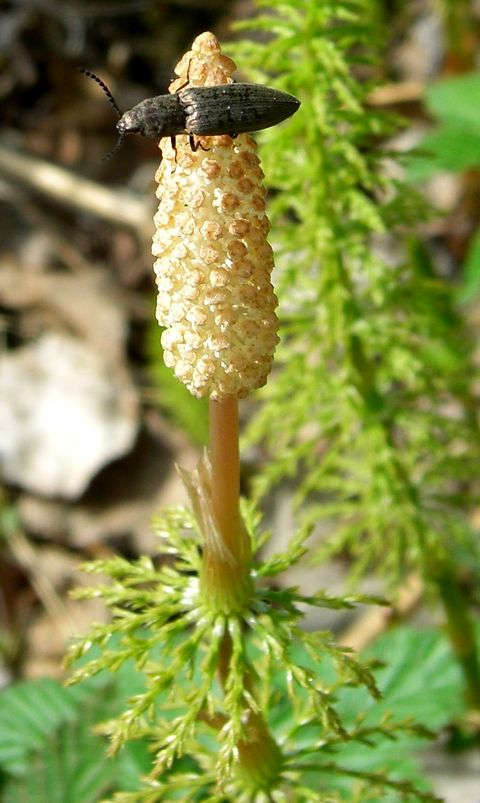
After this inspiring (but brief) side-step from the trees, we can finally return for our examplary from the plant. (Namely, this species is Wood Horsetail, Equisetum sylvaticum). During the Carboniferous (-era, about 360-290 M. y. ago) there was actual forests formed by the now extinct families of the Sigillaria and Lepidondrales (the latter also bear as their common name 'the Scaly trees'). To neither from those early groups any surviving relatives exist on present families of the plants (acc. my understanding), but on Carboniferous there also grew several groups from Calamites, tree-like species that a lot resembled the modern Horsetail-plants (Equisetum) by outer look. These modern plants (relatives for those long vanished trees) are typical sight at the ground levels of Fennoscandian woods, ao places, and sometimes appear on various other comparable environments. Their also really nice to watch when on walks at the forest, one wouldn't really wish go tramping over those.

Equisetum Sylvaticum...See the spore on
top of the plant and leafs
(From beetle I don't know if it has
any relation for the plant; Coleopteran are
assumed evolved rather early on times, too...)


Like their long gone "predessors" on Carboniferous, the structure of the Horsetail stem is similarly hollow and it's 'leafs' grow quite resembling manner on cyclical sections. (Only that those ancient trees were lot larger, for about 10-20 meters height. Also, seems it say that - unlike the modern horsetails - the Calamites had "unifacial vascular cambium" allowing them develop wood and grow in excess of ten meters...) ...But, anyway it's said possible acquire quite a good impression from looks of Carboniferous forests from viewing those small 'green-carpets' formed by modern horsetails. Speaks on behalf their anciety also, that this family of plants speads from spores, similarly like the ferns, and not via pollination (like the later evolved plants). So, an actual relic, straight down here from that period when the present energy reserves only were on their formation. And it has survived almost unchanged for the present era, or only little changed. (Although, most part of that black liquid stuff [*], called crude, likely formed from remains of the fast growing Sigillaria-trees...But, large part also from other vegetation that grew on at the time.)


;[*] Well (...for some late addition/correction, on 23.2.2013). I guess...that I'm obliged say now that after from having written this (I've recognized) it been actually the coal-reserves which did form during those days from Carboniferous (-era) ; ...But, that's actually minor difference on what comes to these futuristic aspects (Oils, Coals, Natural gases ; Climatologically seems that this variety of ways for fossil futures differs only on the scales from some few decades, half the century maybe most... ) So, I've so far let that (minor difference) remain uncorrected, until now. However, having recently viewed that popular science book about the species from dawn of evolution (not only the animals; plants, sponges, archaea, ...etc.) by R. Fortey [Survivors. The Animals and Plants that time has left behind., 2011] ... seems a few quotes added on this also give me reason for that above 'correction'.
Few lines quoted of the book, due them make a nice descriptions from environments at Carboniferous (...of p. 212-3) [...These quoted sentences actually discuss Tuatara, the ancient 'reptilous remnants', found on some New Zealand-shoreline places;] 


"The first fossils recognized by palaeologists as reptiles are Carboniferous in age, about 318 million years old. Footprints, made by these remote second cousins of the tuatara, crossed mud flats where early relatives of the horseshoe crabs still scuttles beneath rotting vegetation; where creeks wandered through the hot and humid swamps of coal forests; while far above giant dragonflies skirted tree-sized relatives of Huperzia [some common 'spore'-plants too, like the horsetails - only them seem be even more ancient of origin], or rested briefly on horsetails and seed ferns. The Bay of Fundy in Nova Scotia, Canada, preserves both footstep and fossil in its sea cliffs. When fires raged through the ancient forests, stoked into ferocity by higher levels of atmospheric oxygen than we have today, hollow tree stumps privded the briefest haven from the heat for fleeing vertebrates, before becoming both their tomb and archive. It is a long journey through time and space from such early reptiles to their living relatives..."  

 ; ...And, here's also neat, compact description about that vascular structure the earliest plants needed form, before being able successfully spread on ground-environments (slightly earlier from geological timing);  p. 156-7:

"During the Silurian, about 420 million years ago, plants were well under way with the most important scene change in the history of our planet since the adaptation of oxygenating photosynthesis billions of years earlier. Plants had moved out of the protective and supportive bath of the waters into thin air. It was a move with unprecedented consequences. After that transformation, animals could follow, and the boundless possibilities of terrestrial life could begin to be exploited by organisms small and large. It started with a few species of herbs around muddy flats ...Huperzia and Baragwanathia [some spec. known of the Silurian fossilous remains] are vascular plants, which means that they have stiffened water-conducting tubes (tracheids) within their stams. This is the most important piece of mechanical engineering required to achieve terrestrial status; without it, plant life on land would have been a flop, in the most literal sense. Think of the hopelessly flaccid condition of seaweeds when the tide goes out. Woody, or lignified, tracheids put the backbone (not in the literal sense, this time) into the invasion of the land: they were supply pipes and scaffolding in one."
...Etc, (he) also discusses on that about this definition ('living fossil'), or more particularly from how it's merely some 'paradoxic' and 'oxymoronic' term, but I don't wish to quote too much at this. ; So, let us close these carboniferous-stories with the emphasize on carbonidioxized  speculations, emphasizing the 'unprecented consequences' ...We're possibly on the edge of some 'deeply mysterious'-questions at our times and result might just turn as the birth of 'completely new man' & era on the world-history.  (; ...For now,  returning to the main story at this...)


Finally it is also mentioned that Fennoscandian Nature being enriched from large variety of (Equisetum-) species, actually; I even find it said that almost half of the still remaining little over dozen species are presently existent there. Why so, I've not quite been able to figure out, although feels at least logical that there should appear so many (feels more peculiar, if them aren't more numerous or common on elsewhere places). Anyway, the Carboniferous is described been a period of the moisturic climates and conditions and on present landscapes of Finland (fx) there's quite plentiful small lakes and ponds (Actually, procentually more inland watery areas than at most other areas of the world) ...If that makes any argument/or suffices for good reasons explaining that versatility of Horsetails on Fennoscandias, I don't go guessing. None of them, however, grows for as large as some species on tropics, them seem mentioned to reach even a few meters of height.


And, soforth, that was the chapter about this (actual) Living fossil. Fennoscandian Equisetum (-plants) also are said having mostly benefited from the human effects on woodlands, so I've sometimes picked a few and found it most proper on uses at footbath, (fx). Traditionally, the horsetails – like many plants - also have had a variety of medical uses.
(...Albeit, at least the bogland species (Equisetum palustris) is actually said toxic, so I wouldn't try any of the Equisetum for that purpose without some expertise about them on medicinal use. Often only certain parts from plant - flowers, leafs, etc - appear toxic, while the other parts are not. And also, some plants are only usable when the leaves have just grown, or when they have not yet flowered. And vice versa, etc., ...) (G.U.J.)


-----------------


( The latest posts! - @ Mulskinner Blog @ )


----------
Powered by
ScribeFire.