The Frogs Have More Fun...

Flowers


"All the names I know from nurse:
Gardener's garters, Shepherd's purse,
Bachelor's buttons, Lady's smock,
And the Lady Hollyhock.

Fairy places, Fairy things,
Fairy woods where the wild bee wings,
Tiny trees for tiny dames.
- These must all be Fairy names !"

(from Child's Garden of Verses
by R.L. Stevenson)


"Anyone can write a short-story.
A bad one, I mean."

(R.L. Stevenson)
----------------

"Science without conscience is the Soul's perdition."
- Francois Rabelais, Pantagruel
- Acc to/above is citated from: Medical Apartheid. The dark history of Medical Experimentation on Black Americans from Colonial Times to the Present, by Harriet A. Washington (Doubleday ; 2006 ; p. 1.)

----------------
"In the high society of the first half of the century, marriage, despite it's bestowal status upon the wife, was the most absurdity. Marriage, conferring instanteous rank or money, ... lost most of its prestige and moment right after the wedding. ...By the end of the century, spurred by Rousseau's moralistic Nouvelle Hèloíse, a contrary cult, that of virtue, arose. After 1770 conjugal and maternal love became not merely admissible, but, for some, moral imperatives. ...

[...]
...Rousseau, who sought for himself the crown of morality in ostensibly defending marriage, presents in his Nouvelle Hèloíse the most enticing and extended defense of illicit love ever penned. The root of the problem is that as the century progressed sensibility became confused with morality: passionate feeling, if expressed in a highly civilized mode with grace and nuance, makes us forgive the Rousseau of The Confessions, for example, his pettiness, his jealousies, his betrayals. This moral-amoral byplay, present already in the novels of Richardson, was to be more intense as the century unfolded."
-
Madelyn Gutwirth : Madame De Staèl, Novelist. The emergence of the Artist as Woman (10,15.)

;
"...As the social contract seems tame in comparison with war, so fucking and sucking come to seem merely nice, and therefore unexciting. ... To be 'nice', as to be civilized, means being alienated from this savage experience - which is entirely staged. [...] The rituals of domination and enslavement being more and more practiced, the art that is more and more devoted to rendering their themes, are perhaps only a logical extension of an affluent society's tendency to turn every part of people's lives into a taste, a choice; to invite them to regard their very lives as a (life) style." - Susan Sontag , on 'Fascinating Fascism' (-74; p 103;104-5 at Under the sign of Saturn)
; "Anyone who cannot give an account to oneself of the past three thousand years remains in darkness, without experience, living from day to day." (Goethe) - as cited by Sontag (on same compile; p. 137.)

;
"It is widely accepted that we are now living in the 'Anthropocene', a new geological epoch in which the Earth's ecosystems and climate are being fundamentally altered by the activities of humans. I loathe the term, but I can't deny that it's appropriate."
; (Goulson), Silent Earth : Averting the Insect Apocalypse (2021; p 47.)
;
"It is sometimes said that humanity is at war with nature, but the word 'war' implies a two-way conflict. Our chemical onslaught on nature is more akin to genocide. It is small wonder that our wildlife is in decline."
; (Goulson, 2021 ; 118.)
;
----------------
"If we believe absurdities, we shall commit atrocities." (Voltaire)
- Citated from; (Joy, Melanie), Why We Love Dogs, Eat Pigs and Wear Cows : An Introduction to Carnism(2010; p. 95.)
;

"In the presence of the monster, you have eyes and ears for nothing else."
; (Flora Tristan) : London Journal of Flora Tristan: the Aristocracy and the Working Class of England ; 1842-edit. (tr: 1982. ; p. 71.)

;
"Every minority invokes justice, and justice is liberty.
A party can be judged of only by the doctrine which
it professes when it is the strongest."
Mdme de Staêl
(on) 'Consideration sur le Révolution de la Francaise' [1818]


1/26/12

"Studies from the Elm-trees and virtues"

: MuleSkinner Book Recommends # 32½


(Familiar Studies of Men and Books
by Robert Louis Stevenson, 1882)
[Recommendation I / 2012]


"...And the meek will inherit."
(Holy Bible)


...On some paragraphs at Walden (1845), Thoreau (Henry David, 1817-62) - for whom we've referred quite often recently – writes (smtgh like) that if humans really wished to live in balance with the Nature, forests would begin right out from our own backyards or from gardens of the houses. I've rarely read an opinion truer, or say, a better expressed view about man's relationship for his adjacent environments. Of course, most people in this modern World of our times, hardly can even consider anything like that. I mean, now over some 160 years later, with much different landscapes and world's population count on current levels. Also, in practice it would turn from quite some drawbacks, not the least that living that close for the wild natures enforces one to tolerate it's disadvantages too; Fx, one can think of roots and stems of the plants at garden, eaten by the  animal 'harvesters', or threats brought by predative species (at least endangering for dogs of the household, say.) ...But, very apparently the words on that book were at context which is meant interpereted in the symbolical sense.

Actually, I've lately come to think about these things quite much (About the 19th century views about Nature, mostly). So, I find, it must be no coincidence – as I've also come to think, there ain't no coincidences in this World ...That Stevenson (RLS, recently presented on our recommends) happens have written an essay about Thoreau. Originally the text seems written during Stevenson's journey/stay at New Mexico/US, but it was also published on the Familiar Studies of Men and Books, some 'early essays' collected by Stevenson himself at 1882. (Indeed quite a coincidende – unless we should assume this for some fallacy by his Majesty's making. Unlikely, but not that unforeseen possibility in the light of our experiences about this MSW-world... :) 
Making the (said) coincidence even more hilarious - or humorous, should we say– appears that Stevenson mostly 'condems' and criticizes Thoreau and his opinions on that essay.


How could it be? These great 19th century critics' of the Bourgeiose morales and them should appear hold such "disagreement" to each other ? (...The "disagreement" on paraphrases, of course, considering that it is only the Stevenson's appraises or opinions from the other we have here. Thoreau had been dead by some 20 years earlier). It appears that the essay is mainly written on basis of reading most renown writings from Thoreau, which he (RLS) also mentions on the forewords for this essay-compilation. (I've only read Walden, so my excuses if I manage to miss some important aspects at this brief commentary.)


Stevenson's words are indeed, not only quite harsh, theyre often filled with negative expressions; Thoreau is termed fx for a "skulker", and "prig"...And to make his opinions even more clear, at the end of essay that "eccentric and independent mind" is also described "part gymnosophist, part backwoodsman" - All the expressions by italics are from the Stevenson's used words (or, so we at least should assume...). ...Perhaps it is not too surprising find such a lively words and expressions from that 'word-mill', but I feel he (RLS) at least misses a main points about Thoreau's 'philosophy' (rather odd marriage, or a mixture from the Orientalist philosophies, antique classics, ao), when he disapproves that 'lack of action' (by T.) with words: "If nothing were to be done but build a a shanty beside Walden Pond, we have heard altogether too much of these declarations of independence. That the man wrote some books is nothing to the purpose, for the same has been done in a suburban villa."


...On the other hand, has to be reminded at this too, that Stevenson actually devotes quite much space on collection's forewords for this essay in particular (With quite apologizing words, including, fx; "[…] Thoreau's theory, in short, was one thing and himself another.)" Also, noticeable that on none other from his [RLS's] essays at these 'short biographies' is there so much citing from writings of the subject discussed (It's quite useful introduction for Thoreau's thinking, actually.) Whatever one thinks as main reasons for the Stevensons first-hand impressions, the reader has feeling that he (RLS) had some devoted effort for understandings views/philosophies by his subject of study. So, I leave it to anyone interested figuring out what the actual reasons for such judging arguments. (I suppose, it would be too easy an explanation trace them for Stevenson's own views of the Nature, often enchanting and impressive, but also sometimes typically 19th centurian romantical looks for the surrounding environments and the 'undisturbed' wilderness of the countryside.)
 

...From the other essays of this collection (Familiar studies...) many are also as much interesting, it is fair to say. It is also as much correct to say that Stevenson can't by any means be merited as the most accurate 'historian', or being very precise from the historical detail(s). Or, a 'historian' at all (even in the 19th centurian sense of the term) ; But - he never even too seriously intends to be.

However, read as some fictional, well-studied portraits the essays are (mostly) very good. Not any 'lazy man's history', but perhaps some for an 'easing man', one could say. (Or, readings of the literary vagrant, to use Stevenson's own words.) There's equally much that romantical historism - rather typical for the 19th century, at literature and on scientific historical study -  but, at least as much sarcasm on his (RLS's) words. If seeking any uniting element, perhaps most noticeable feature is that major part is from the poets or literary authors. (Of course), may also be worth mention that all - like the name says -are familiar studies of men (and books).


Anyway, that lot appreciated essay from Robert Burns (1759-1796, Scottish poet) I only did find mostly over-romantical and -patriotic (to the level of the 'flags, cash-boxes and parades', nowadays equally common, but more often seen fx at cartoons for kids et similar entertainment, also typical for those movies triumphing some 'americanisms') But, of course, each country has it's own literary heroes and revivalists of traditional languages. (Only that those more rarely appear of  similar importance from the outsiders view-point, ie for a foreigner). To the contrary, fx the essay 'John Knox and his Relations to Women' is a more rewarding reading even today, at least acc. my judging.  (Knox, Scottish reformator, 1510-92, wrote a famous pamphlet  about controversity of the female rule...a hot topic at it's own times and seems have inspired Stevenson for his essay.)
...For the fun of it, reader is advised to have a look on some (or any from) those essays. What makes them still most readable is that skill on words by Stevenson, his 'wordyness' actually. Collection contains fx the following delicate 'gems for the sentences' on art of assessing cultural and religious 'ethos' of any past era by few words (to pick just a few examplary sentences here...):

(From Charles of Orleans) ; "And I think it scarcely cynical suppose that religion as well as patriotism was principally cultivated as a means of filling up a day."
- (Pepys) ; "...When he began the journal, he was a trifle prim and puritanic; merry enough, to be sure, over his private cups [...] Tag, rag, and bobtail, dancing, singing, and drinking, become his natural element; actors and actresses and drunken soaring courtiers are to be found in his society; until the man grew so involved with Saturnalian manners and companions that he was shot almost unconsciously into the grand domestic crash of 1668."
- (Knox) ; "Ministers placed Berwick and such places might seek their converts equally on either side of the march; old enemies would sit together to hear the gospel of peace, and forget the inherited jealousies of many generations in the enthusiasm of a common faith; or – let us say better – a common heresy. […] A new creed, like a new country, is an unhomely place of sojourn; but it makes men lean on another and join hands. It was on this that Knox relied to begin the union of the English and the Scotch." .

(And soforth, etc., ...) ; W-G.

-----


------------

( The latest posts! - @ Mulskinner Blog @ )


----------
Powered by
ScribeFire.

1/13/12

The Undesigned Chapter : Part VII

; The S.O.P.


Delacroix's painting (1830).


Having spend most of my life as follower for practices of this modern and mobilized world (World of cars and fuels, the limitless production, the consumerist life-styles), I've only recently have began to think about it more closely. There's levels on that consumerism, there's levels on ecological disturbance, but all in all there's none a more enslaving product than is the car.


So, nowadays when I see my fellow companions and contemporaries 'damning' the price-lifts on the gas station, I don't much share their annoyance (of that matter). Actually, I more often cheer up and say Hurrah! (...And Yippee!). It's not from the reason that I'd feel any compassion or sympathy for those greedy and monopolistic companies, hoping to squeeze out every penny from the consumer's endless appetites for driving and spending their money on that. No, it's merely from the reason that I've begun to hope that the ever-raising prices would some day push my fellow men for think about how obedient and willing they are for exchange their earnings to nothing ...And, how our societies still are (almost completely) built on base of that oil economy.


One can of course defend one's own driving (and kilometers) under the pretext of how inherent that oil-economy is on our current culture. There's large amounts of it behind each part of modern production; Drops of it spend on most every stuff produced on agricultures and what reaches us (consumers) on markets. Amounts used (fx) on the production of fertilizers, amounts on transport sector, etc. Also, the various 'co-products', the plastics, etc. Most every chain in the production consumes - more or less – oil.


Much of that could have been built otherways, if the modern World (and societies) were been developed differently. But, at the end of it, one cannot either avoid the logical question that almost instantly formulates; How should we relate our own life-styles (notice that the preceding word is in the plural...) to that ? Or, what should I think about this economy myself? And there we are, the Slaves of Petroleum, enslaved by our own appetites for driving and that comfortability on movement.


Of course, it's also so that passing those (large) distances between places would often be difficult, unless we'd have the cars on uses. On some cases going to places without car would turn out unpossible. (Also, and more often, there's not any other option available for carrying larger amount of stuff to any particular place.)


Yet, it all appears so much due the driving economy being so integral part of those individual lifestyles. Nowadays - as I find myself little better understanding the real price of it (the price passed for the environments) - I actually always try first consider whether there's any reason for uses of car. And, inspired by this late emerged environmentalism of mine, I often find myself lots more happy if I succeed evade that habit we're all so accustomed for (ie having to drive). In fact, I find, that I'm lot better capable seeing everything around me when on the move without car (whether it's the trees, other creatures, landmarks, doesn't really matter). Equally true, appears usually more refreshing manner of movement than having to sit enclosed on that (mercifully air-conditioned) gasoline-fuelled maccina, hands tightened at the wheel and keeping watch of traffic signs. And, so much more relieving when one comes to think about not at that moment participating for the current 'Greenhouse cargo' generating (and, mostly just passed for future, or, the further generations to come).


There's nowadays several/various 'smaller scale' choices that permit a consumer to limit one's own enslavement for car (and for comparable transportation means); Start thinking the car just as vehicle, not as the investment; Start thinking changing for those modern hybrids, etc. But in brief, let these words be concised for the (metaphorically spoken) sentence that you become what you drive for. ...And (less metaphorically); The actual Revolution always begins from where begins the revolution of the mind.


(Also is noticeable), that by origin the oil reserves - now spend so carelessly by present human cultures – were formed of the plant matter that once grew at the humidious climates of Carboniferous era, during a time-gap of some hundreds millions years. (Carboniferous age was roughly 350 Million year in the past.) So, no wonder the environmentalists and climatologists so often tend to talk about that careless waste of non-renewable energies – in fact it's spend there continuously for the gasolines and stuffs, straight out from Mother Nature's pockets; Resources which took some unimaginable periods of times to accumulate (from view-point of/compared to any human timescales).


--------------

...What comes to our series from Fennoscandian insect and plant, we now only have an example from the latter mentioned under observation at this sequel. However, it's more than proper selection, also considering above words/ paragraphs.


On biological terms this plant in question is mentioned a representative from a (so called) 'living fossil'. Seems it said that a living fossil can either be a singular species that resembles more some foregone plants - ie those only known from fossilized material - than any currently extant group. On the other hand, living fossil(s) can as well be some species (or, usually group of plants) that have survived almost unchanged since from distant past, typically past millions years, and, resultatively there ain't any existent 'closely related species' for them. (Our exemplary species suffices to meet the latter described criteria; It belongs to a group that is ancient family among plants).


As the N.European landscapes only have 're-appeared' for their current state after passing of the latest ice ages, there fx ain't any species of the tree that could have reached our modern era/times from that far. (Neither there's not plants that would be regarded as 'living fossil' by the first described criteria , but several succeed to meet conditions of the latter presented.)

On the warmer latitudes there's also some trees from that ancient origin, I find it said. Fx, Gingko (Gingko biloba), a species of tree whose closest relates are dated to have existed from (around) Late Permian (about over 250 Million years ago), until sometime later (for the Jurassic). The whole group (Gingkoceae) seems been assumed among earliest trees that emerged early on that particular period from their 'flourishment on Earth'. Practically all the oldest tree genera belong for the Gymnosperms - Ie them are conifers generally, sometimes also referred as the Pinopsida, species with (so called) 'naked seed'; Them already existed even before the appearance of flowering plants (so called evolution of the Angiospermsabout 130 Million y. a.)


This tree (Ginkgo) has been known (for science) at least from the 19th century as it is popularly grown on parks and as the roadside tree at China (and probably from since/around that century, or little later, has been planted and cultivated for similar uses on fx Europe and American continents). Yet, not until 1950s seems it been recognized from such anciety by origin. The closest modern relatives of Gingko seem traced for the Cycads (Cycadales), present on various places from subtropic. The Cycads are also rather old lineage from earliest origin and the resembling species, or 'predessors' for their modern genera, flourished during the Trias- and Jurassic periods (roughly 250-150 M. year ago). Nowadays there exists only about 150 separate species. However, the Gingkoceae at least formerly were believed having evolved prior the emergence of modern conifer (-trees) and also from to have preceded the extinct Gnetales. (Modern research seems have re-arranged their supposed evolutionary relations by somewhat). Interesting also, that "needles" (of the Ginkgo) seem considered rather archaic and by looks them seemingly resemble more the leaves of deciduous tree than the conifers (…If wish to make any comparison to modern species of trees. Actually it's 'leafs' are said having quite unique structure among the existent trees). On N. American continent also survives some rather ancient forests, particularly the giant Redwood trees that belong for the Cupressaceae ...And their relates, this group (apparently) contains some very old genera among extant pines [...well, precisely Cupressaceae not belong to the pines, but to a more wider and more archaic group from the conifers (apparently, it's the pinus...supposedly)]

...From other ancient 'oddities' for tree seems it also proper mention the Australian Wollemia (W.nobilis), a tropical conifer related for Araucarias (Araucariaceae), and from which also is said that it's closest actual relates/similar trees existed around the Jurassic period. The few surviving Wollemia are mentioned consist of only few hundred singular trees, but I find also mentioned nowadays grown some exemplaries of it on botanical gardens, and as well there being cultivated species (or breeds from?) grown and sold for uses as household plant. However, the actual natural trees seem also mentioned to having suffered of some diseases, inflicked (apparently) by the unauthorized visitors on their growing site. So them are nowadays only allowed visited by the biologists, etc. Often such 'relic' species appear also vulnerable, even fragile to disturbation, in fact. (Also, seems it being that Wollemia may have 'resurfaced' for popular knowledge just around the time when those Dinosaur-movies were on theaters, 1994. ...But on the light of this, wouldn't it perhaps even be a complete unpossibility if there still would exist at some other places of world similarly exciting representatives of an actual Living fossil from Dinosaurian age (If wish use that term, and, meaning the very ancient trees and not the Dinosaurs, of course...)


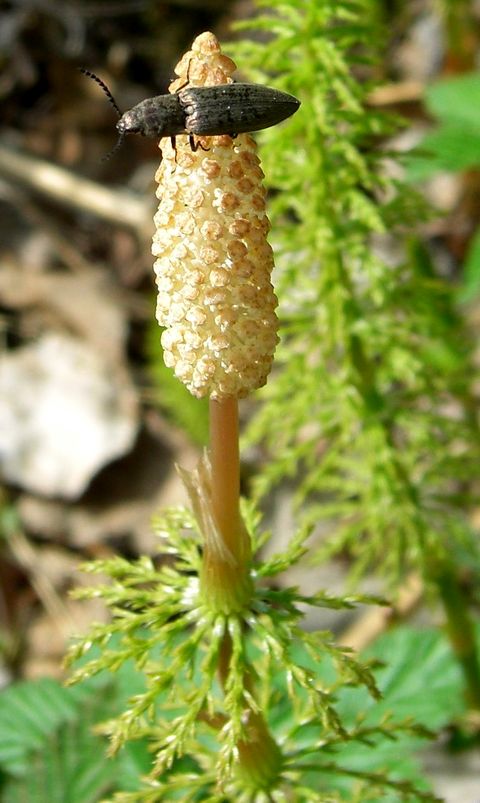
After this inspiring (but brief) side-step from the trees, we can finally return for our examplary from the plant. (Namely, this species is Wood Horsetail, Equisetum sylvaticum). During the Carboniferous (-era, about 360-290 M. y. ago) there was actual forests formed by the now extinct families of the Sigillaria and Lepidondrales (the latter also bear as their common name 'the Scaly trees'). To neither from those early groups any surviving relatives exist on present families of the plants (acc. my understanding), but on Carboniferous there also grew several groups from Calamites, tree-like species that a lot resembled the modern Horsetail-plants (Equisetum) by outer look. These modern plants (relatives for those long vanished trees) are typical sight at the ground levels of Fennoscandian woods, ao places, and sometimes appear on various other comparable environments. Their also really nice to watch when on walks at the forest, one wouldn't really wish go tramping over those.

Equisetum Sylvaticum...See the spore on
top of the plant and leafs
(From beetle I don't know if it has
any relation for the plant; Coleopteran are
assumed evolved rather early on times, too...)


Like their long gone "predessors" on Carboniferous, the structure of the Horsetail stem is similarly hollow and it's 'leafs' grow quite resembling manner on cyclical sections. (Only that those ancient trees were lot larger, for about 10-20 meters height. Also, seems it say that - unlike the modern horsetails - the Calamites had "unifacial vascular cambium" allowing them develop wood and grow in excess of ten meters...) ...But, anyway it's said possible acquire quite a good impression from looks of Carboniferous forests from viewing those small 'green-carpets' formed by modern horsetails. Speaks on behalf their anciety also, that this family of plants speads from spores, similarly like the ferns, and not via pollination (like the later evolved plants). So, an actual relic, straight down here from that period when the present energy reserves only were on their formation. And it has survived almost unchanged for the present era, or only little changed. (Although, most part of that black liquid stuff [*], called crude, likely formed from remains of the fast growing Sigillaria-trees...But, large part also from other vegetation that grew on at the time.)


;[*] Well (...for some late addition/correction, on 23.2.2013). I guess...that I'm obliged say now that after from having written this (I've recognized) it been actually the coal-reserves which did form during those days from Carboniferous (-era) ; ...But, that's actually minor difference on what comes to these futuristic aspects (Oils, Coals, Natural gases ; Climatologically seems that this variety of ways for fossil futures differs only on the scales from some few decades, half the century maybe most... ) So, I've so far let that (minor difference) remain uncorrected, until now. However, having recently viewed that popular science book about the species from dawn of evolution (not only the animals; plants, sponges, archaea, ...etc.) by R. Fortey [Survivors. The Animals and Plants that time has left behind., 2011] ... seems a few quotes added on this also give me reason for that above 'correction'.
Few lines quoted of the book, due them make a nice descriptions from environments at Carboniferous (...of p. 212-3) [...These quoted sentences actually discuss Tuatara, the ancient 'reptilous remnants', found on some New Zealand-shoreline places;] 


"The first fossils recognized by palaeologists as reptiles are Carboniferous in age, about 318 million years old. Footprints, made by these remote second cousins of the tuatara, crossed mud flats where early relatives of the horseshoe crabs still scuttles beneath rotting vegetation; where creeks wandered through the hot and humid swamps of coal forests; while far above giant dragonflies skirted tree-sized relatives of Huperzia [some common 'spore'-plants too, like the horsetails - only them seem be even more ancient of origin], or rested briefly on horsetails and seed ferns. The Bay of Fundy in Nova Scotia, Canada, preserves both footstep and fossil in its sea cliffs. When fires raged through the ancient forests, stoked into ferocity by higher levels of atmospheric oxygen than we have today, hollow tree stumps privded the briefest haven from the heat for fleeing vertebrates, before becoming both their tomb and archive. It is a long journey through time and space from such early reptiles to their living relatives..."  

 ; ...And, here's also neat, compact description about that vascular structure the earliest plants needed form, before being able successfully spread on ground-environments (slightly earlier from geological timing);  p. 156-7:

"During the Silurian, about 420 million years ago, plants were well under way with the most important scene change in the history of our planet since the adaptation of oxygenating photosynthesis billions of years earlier. Plants had moved out of the protective and supportive bath of the waters into thin air. It was a move with unprecedented consequences. After that transformation, animals could follow, and the boundless possibilities of terrestrial life could begin to be exploited by organisms small and large. It started with a few species of herbs around muddy flats ...Huperzia and Baragwanathia [some spec. known of the Silurian fossilous remains] are vascular plants, which means that they have stiffened water-conducting tubes (tracheids) within their stams. This is the most important piece of mechanical engineering required to achieve terrestrial status; without it, plant life on land would have been a flop, in the most literal sense. Think of the hopelessly flaccid condition of seaweeds when the tide goes out. Woody, or lignified, tracheids put the backbone (not in the literal sense, this time) into the invasion of the land: they were supply pipes and scaffolding in one."
...Etc, (he) also discusses on that about this definition ('living fossil'), or more particularly from how it's merely some 'paradoxic' and 'oxymoronic' term, but I don't wish to quote too much at this. ; So, let us close these carboniferous-stories with the emphasize on carbonidioxized  speculations, emphasizing the 'unprecented consequences' ...We're possibly on the edge of some 'deeply mysterious'-questions at our times and result might just turn as the birth of 'completely new man' & era on the world-history.  (; ...For now,  returning to the main story at this...)


Finally it is also mentioned that Fennoscandian Nature being enriched from large variety of (Equisetum-) species, actually; I even find it said that almost half of the still remaining little over dozen species are presently existent there. Why so, I've not quite been able to figure out, although feels at least logical that there should appear so many (feels more peculiar, if them aren't more numerous or common on elsewhere places). Anyway, the Carboniferous is described been a period of the moisturic climates and conditions and on present landscapes of Finland (fx) there's quite plentiful small lakes and ponds (Actually, procentually more inland watery areas than at most other areas of the world) ...If that makes any argument/or suffices for good reasons explaining that versatility of Horsetails on Fennoscandias, I don't go guessing. None of them, however, grows for as large as some species on tropics, them seem mentioned to reach even a few meters of height.


And, soforth, that was the chapter about this (actual) Living fossil. Fennoscandian Equisetum (-plants) also are said having mostly benefited from the human effects on woodlands, so I've sometimes picked a few and found it most proper on uses at footbath, (fx). Traditionally, the horsetails – like many plants - also have had a variety of medical uses.
(...Albeit, at least the bogland species (Equisetum palustris) is actually said toxic, so I wouldn't try any of the Equisetum for that purpose without some expertise about them on medicinal use. Often only certain parts from plant - flowers, leafs, etc - appear toxic, while the other parts are not. And also, some plants are only usable when the leaves have just grown, or when they have not yet flowered. And vice versa, etc., ...) (G.U.J.)


-----------------


( The latest posts! - @ Mulskinner Blog @ )


----------
Powered by
ScribeFire.

12/16/11

The MuleSkinner Book Recommendation # 32


Robert Louis Stevenson : Black Arrow (1883) / Child's Garden of Verses (1885) 

[Recommendation(s) V / 2011]


"The air was raw and pointed, but not far below freezing, and the flakes were large, damp and adhesive. […] High up overhead the snow settled among the tracery of the cathedral towers. Many a niche was drifted full; many a statue wore a long white bonnet on it's grotesque or sainted head. The gargoyles had been transformed into great false noses, drooping towards the point. The crockets were like upright pillows swollen on one side. In the intervals of the wind , there was a dull sound of dripping about the precincts of the church."
(From)  Lodging for the Night – A story of Francis Villon (New Arabian Nights, p. 1882)

...Cited sentences on begin of this recommend I thought for a good excerpt to show some best elements at the Stevenson's (1850-94) depiction and narration. Although in the most stories it's the catchy narration that perhaps plays most meaningful part, his writing often finely describes places and surroundings too. This excert (and the story) seems mentioned to belong for his earliest written fiction (or at least published), so maybe it is also even bit more carefully built than some later wrote stories. But, typically it has nice paragraphs from the place, situation and the circumstances (The weather), which then lead the reader for the actual story.


Treasure Island map from books
19th century edition.
(pic from Harman's biography)
This recommendations sequel resulted originally from abrupt awakening to notice that I hadn't read much anything from Stevenson [RLS]. Even that the author is a world renown of couple of his books; Other that (perhaps) most popular adventure story for the youths (and adult), The Treasure Island (1883) (...or, 'Sea Cook' as the manuscript originally was named). The other famous book of RLS, The Strange case of Dr Jekyll and Mr Hyde (1886), is not quite as famous, but appears be some cornerstone on horror from the 'Victorian era' (that late 19th century). It is said not read by so many, but book even preceded emergence of modern psychology as the scientific theory, and also has later settled for part of a common language. (So, the Jekyll/Hyde often is loaned to language as synonym for a term referring to so called "split personality"). More generally the book itself can be described as the most borrowed source at much of the 20th century popular fiction/entertainment. Take, fx, almost any popular movie containing elements of horror or fantasy, and most likely there's something on the characters/scenes/etc., inspired from this classic story. (...Of the movies that I've recently seen fx the Gremlins – in particular 'New Batch' (1990) and Lords of the Rings (2000s) first come to mind. But you name it, there's probably lot more examples than it's equally numerous adaptations for the film and stage - Which, seem said count well over the hundred separate adaptations, solely).


Anyway, as I had read both of the books mentioned and not much anything else from RLS (like most people, probably), I made a little effort to mend that hole at my literary knowledge and also took on to read Claire Harman's biography from Stevenson. (Listed at the end of this post). Harman's biography doesn't completely escape from that 'maze of gossippean stories' and other stuff (feels to me that's somewhat 'besetting difficulty' for almost anything written about Stevenson's life and works). Yet, the biography succeeds make a good literature portrait. ...So it's also some alternative recommended reading at this instance. Of course, there seems be plentiful biographies been written, old and new. (At least, couple other books seem seen the light during latest decades ...Probably there's even some more as the Stevenson study is said have 'relived' renaissance during/since about late 1990s.)


The strange (literary) place of the (author) R.L.Stevenson. Despite of that the mentioned books (solely) form the better known fiction written by RLS, recent research seems have recognized him for very productive author. Only that Stevenson's most passionate habit was starting ever new projects of which relative few were finished. (Harman fx seems notice at her introductive words that RLS 'made great many beginnings and relatively few ends'). Considering the previously said, and also Stevensons ill health, seems actually even more surprising that he was able finish such excessive amount of texts. ...(According Harman) the total extent of RLS's unpublished works had not become more clear until about 1980s. The combined works seem said list closely 400 separate items; And so she as well writes that '[Stevenson] with a little push one way or other might not've been known as author of Treasure Island and Dr Jekyll & Mr Hyde but as playright of 'Kings' Rubies' and biographer of Viscount Dundee.' Also, fx it is noticed that the actual reason for that Treasure Island – like also the historical novel Black Arrow, book viewed later at this, and another renown novel Kidnapped (p. 1886) - to ever even were finished, was because Stevenson was writing them to a Youth Folks (a magazine) and wouldn't allow himself to disappoint his young readers on that case. Also, Harman seems fx say that the 'sense of urgency about establishing himself as a writer that Stevenson felt and his friends shared was sharpened by their concept of him as doomed to die young.' Hence the great many unfinished works, or at least feels logical for assuming so.

Stevenson was already at his own times recognized for quite peculiar character (explains also, at least partly, the large number from later researches and studies). His life contained many a struggle because of his ill health, however that didn't prevent it from having contained exciting chapters and circumstances. In spite of his (relative) brief life he made rather exceptional travels (Or, some real life 'adventures', at least so those must have seemed on his own times, and still do... Seems it been remarked that those sometimes were as adventurous than his best stories; Fx, the journey to meet his later wife has episodes that almost give an impression of being from some later western-movie. - And, vice versa, actually some of RLS's stories succeed reach very great realistic tone, to a level that them much feel like real-life episodes). But to keep this brief, it could also be fx said from him to have '...tramped on many places of Earth, camped frequently with the "Bohemian queen", and hastened at his days to accomplish several many projects and stories.' (...of course, previous just some verses of my own inventing...).


As the author Stevenson already was well appreciated even prior his wider fame (which was on mid/late 1880s), only that he (seems) 'failed' ever to have delivered some full-lenght masterpiece that would have canonized his place as a 'serious author' in the contemporary criticism. (And also secured some recognized status in the eyes of later criticism.). Due that perhaps, after Stevenson death, his status mostly was settled for that of a world renown writer of youth adventures et similar. More of this literary reception, and later de- and re-canonizations can be viewed fx from Stevenson's bio at Wikipedia (; Under topic modern reception).


The study of some recent decades has also recognized certain texts of RLS's for early 'precursors' of the post-modernist writing. Also, Harman writes that the detective character of RLS's creation (on New Arabian Nights) a lot inspired A.Conan Doyle (1859-1930) when he put on paper those famous Sherlock Holmes-stories.
The newer studies from life and works of RLS seems make equally large amount in total; Random search from the local database listed me about 300 items. (Although those possible contain number of entries to some unrelated texts also). ...Anyway, I've only listed couple of those at further readings on this. There's some book that I thought might be interesting because it discusses the influence(s) of the evolutionary science on Stevenson (or his writing, apparently). Stevenson was, along with his various other readings, well famialirized about views of Darwin (which also brought disagreement with his father, although the relations later somewhat settled). The other research I picked just because it seems interestingly adjoin that Jekyll & Hyde story for the cultural and technological changes at the late 19th century (discusses as well how some other novels reflect that) ...That's actually some 'close-reading' from those novels and contains quite theoretic terminology, etc. But seems an interesting view-point also, anyway.
Like noted earlier , the works of RLS seem very multisided. It's said that the planned and finished works contain fx historical biographies / researches, essays, poems, literary theory, travel books, pamphlets and also large correspondence (typical for people at that time, of course). There's (ao texts) fx many travel essays with the very nice descriptions from places and natures, roads and towns, etc. Actually (feels to me) that those essays are sometimes more interesting reading if compared than some of (his) fiction/novels - Due because many from the latter mentioned might feel a bit dated from a modern reader's perspective.


For his last years (due health reasons, around later 1880s) Stevenson moved to Samoa. His writings from that time (In the South Seas, 1896) also fx take keen interest for the negative consequences from European colonization of the Polynesian islands. ...Which were view-points not so commonly noticed by most from his comtemporaries. Stevenson wasn't of course first European novelist to arrive or write from those places - fx, Herman Melville (1819-91) has a few renown books from mid 19th century Pacific. Yet, few other thinkers at the time probably ever paid much attention for such questions as the drastic depopulation of native people on Polynesia (much due the European brought diseases, ao), or the colonial politics at the time. From some part Stevenson's text maybe reflects it's own period and attitudes, and them likely were influenced by the 19th century social sciences; Herbert Spencer's theories about nations and races, most probably. But Stevenson's writing always is very fresh, sometimes even surprisingly modern when viewed of today's great distance of time (Although, that was written closer the turn of the 20th century.). Also, 'South Sea' texts have often been found of interest and frequently cited at many later study/by researchers. (Stevenson himself actually considered those articles and essays only as sketches to book(s) thought to be later published, but that never realized. And so the texts appeared just after his death.)

However, those later years has to be left for these few remarks here. There's also fx 'A footnote to History, Eight years of trouble in the Samoa' by RLS (1891), written as some direct criticism of the colonial politics of it's time. Although that also never received much attention, it makes an example from Stevenson's (political) activity at the time. For the interested there's of course also various texts from the era, and as well later books and studies about that 'Stevensoniad' on Pacific...


Finally, a brief return for that classic Jekyl/Hyde-story (...Because seems it always to resurface on various contexts): Basically it's said usually interpret as a story from the good and evil (Or, story about the 'Evil that haunts all men', in case we wish to use such phrase). Harman seems also mention the other quite appreciated horror-tale by RLS, Markheim (1884). That is sometimes considered/seen form an early source for that Jekyll/Hyde-novellette. Short-story (Markheim) is also said having a lot similarity with the Dostoevsky's (1820-60) The Crime and punishment (p. 1866). Feels to me rather interesting (also thinking the later creation of a Jekyll/Hyde story), because there's indeed lot in common on 'Author-portraits' from Dostoyevsky and Stenveson.  Both are fx realists but in both cases that realism is somewhat 'odd', even bizarre. Also, they seem find more interest for their evil characters than the more 'honorable' personnel. (Or, alternatively stated, to both author's the question about human capability for evil deeds plays a crucial part on much of their writings/fiction.)

Anyway, the book (ie Jekyll/Hyde novellette) has always been an enormously influential story. I'm also to mention from my own earliest experience of the book. I happened to loan it as an audiobook. If told by some by good reader it's at least lot more thrilling than most filmations of the story. (With the original text, of course.)


Conventional 'abnormal' story for the boys. (...and some 'childish' poems). The book selected here are only some that I had time to read recently. Perhaps no coincidence that them both represent 'youth' fiction. Black Arrow (books also known by subtitle Tale of the two Roses), is a story situated on period from War of the Roses (Battle for power between the parties of York and Lancaster in the middle-age Britain - Actually, perhaps the reason I chose just this book for our example, was because I years ago read the story from some cheap comics magazine. Don't recall if the mag even had the name of the story's original author printed, possibly not, but anyway I was later somewhat surprised to find it actually been written by RLS).
In brief it's a historical youth fiction, rather typical to it's publication time. Black Arrow was written for some kind of following to the hugely popular Treasure Island, for the book also was at first published on Young Folks-magazine (on 1883, it not appeared as book before 1888). Like the treasure Island, story was originally published under pseudonyme, but it's writing appears been quite different process. Black arrow is said been put for paper during just about a couple months period. That somewhat shows, and basically the book is indeed quite conventional historical novel; The main hero appears almost insignificant of characteristics, the plot follows very unsurprising paths ...And even the ending ain't very inventive or original. Story's elements contain fx the revengeful Robin hoodian-bowmen, knighthood stories, castles and battles, and, the necessary romance.

...However, fx the introduction to story (or, how begins this adventurous youth fiction) is somewhat peculiar. Reader is lead for the story with a scene where some of it's characters kind of foretell the events to follow (chapter is also used for to describe those vengeageful arrows that form some main theme on books story-plot). It appears quite strange setting for begins of this kind youth fiction of the 19th century. Book also has lot purpose for (some morally valuing) realism, particularly what comes to the depiction from some of  it's characters. Of course, that also makes the book little contradictional, seems that there's passages written purely in form of typical romantic fiction and then, occasionally, chapters where this 'strive' for 'realism' prevails to the point that result appears quite confusing, and not very successfull in either way. But, Black Arrow is not a total failure for a book of it's kind. Considering how quickly it was written it's actually quite good. (Even though, Stevenson himself seems said have disliked novel on his later comments about it.)  In spite of that, the book also has found it's way for readings at some old youth books classics series - Accompanying there novels by other famous youth fiction authors, such as Defoe, Kipling, Verne, Sienkiewicz...


...A cover from books early 20th century edition
 (from it's Gutenberg text).

"The Moon has face like the clock in the hall;
She shines on thieves on the garden wall,
 and harbour quays; And birdies
asleep in the forks of the trees."
Our additional selected recommend, Child's garden of Verses (1885), is a book of some prose lyric. The story tells that RLS was writing the book in during a period of his repeating illnesses that practically prevented all his other work. Makes it actually even more respectable an achievement. Said also from always been amongts his most beloved books, at least on his home country (The book also has been translated for quite many languages, most probably). Written in a form of lyric-prose, Child's garden of verses has somewhat random collection of little 'poems', or stories told in the childish manner (or, from a view-point of a child). A lovely little book, recommendable for the adults just as well. (And, as I don't usually read much poetry, this should be enough said on this. I guess that also gives us additional good reason  select it too for these recommendations of ours.) (W-G.).


 ------
 
(Some) suggested further readings:
  
Book cover (Biography).
Harman, Claire : Robert Louis Stevenson. A biography. (Harper Collins, 2005)

Law, Jules: There's something inhuman about Hyde. (Forum on Fiction. V.42 Iss 3, p504-510 ; DOI: 10.1215/00295132-2009-048 )


Reid, Julia: Robert Louis Stevenson and Evolutionary Science. (2002)


(...And probably there's a multitude of pages on web, devoted for Stevenson and his fiction.)

--

( The latest posts! - @ Mulskinner Blog @ )


----------
Powered by ScribeFire.

11/18/11

The Undesigned Chapter, Part VI.


; The Frogs, the Hogs and '...few observations about ambiguity of eating meat'


People often find lots to talk from foods. Not surprising, for in the modern world questions of human food supply are ever increasingly discussed (Due the aspects from global warming, but also of the view-point of global equality). At most basically, food economics is rather simple. People with food, sometimes plentitudes or or overwhelmingly, find the food usually a reasons to gather together, servings and menus, discussions and jokes, ao. People with no food only would hope having some, and hardly there's chance for much else about the foods.


As we've lately had quite much to say from  food we'd obviously count  on the  former mentioned. Saying anything else would be pretending for ourself, certainly. So, at this it is aimed make some contemplations from and about food, the meats mostly. Purpose is not to offer any unflexible or very comprehensive argumentation, but individual experiences/thoughts from.

Of the human diets my personal view-points have within time turned favoring quite balanced combination. Meats in general, I think, become less suitable or less necessary part of diet the older any personnel (he or she) gets. On the other hand, I wouldn't myself at most circumstances think any solely vegetarian diet to most practical choice, at least on the current situations of my life. But, I feel the vegetables and similar make very good main basis on that diet. By coincidence, happens also that my favored 'veggies', or some I perhaps most often use, mainly contain those 'Three sisters' that N.American native agriculturalist people/tribes mainly cultivated; The beans, squash(or, 'zucchini'), and from somewhat lesser extent, maize. Of course contains some other varying alternative, too. (Not excludes the cereals/grains and some fruit, either. I guess, I'd get along mainly with those on the summers, if not just solely. Also I fx consider the (organic) milk quite inevitable and necessary for the human body. And no place for soya on my diet, except on sauces.).


I also consume meat and fish, more or less regularly. Fx, if making any heavier physical tasks, or traveling for the longer distances without any fuelled external aid (read: the car), I find meat often for a most proper and compact energy source. Appears easiest to carry along and often also burns more lastingly, if compared for most any vegetable(s).
(Generally), I also don't have too much belief on peoples capability from limiting their global consumption of animal protein in the long run. (I think) without some kind of domesticatated animals – more or less always been kept – wild animal populations would've gotten lot more harmed until the present day (...Although, in that case a human population growth wouldn't perhaps ever have  gone quite similarly,  and neither reached it's exponential levels in during  the most recent centuries, most probably). History offers lots examples from how certain formerly populous animal species may have been massively hunted and declined for their scarce remains from original natural extent (...Although, not always due from the hunt for foods.) In a world of several billion people, feels to me, it's quite impossible think any societies without some stocks of the domesticated species maintained.


...Yet, one shouldn't either dismiss from noticing various arguments against the global meat markets (like that widely spread phrase/slogan 'Meat is murder'). There's as well that popular book of this aspect by Jonathan Saffron Foer (Eating Animals,published sometime during the 2000s). From some reason I've not felt need from viewing the book on backgrounds of this discussion. (Mostly probably due from having felt myself to have learned enough from this modern mass production of foods. Or, that maybe is from due I've just felt properly enough informed from these ethical dilemmas on 'meat production chain' already, and, as it's often easier avoid thinking too profoundly the questions of the foods, bypassed it. Recommendable reading anyway, probably.)

If spending sometime on the natures it's also quite easy reach some understanding about that there being something unpleasant eating meats. Personally people perhaps might interpretate that feeling quite differently, but I understand it perfectly well (Although haven't noticed that preventing me from eating meat). More precisely - and for to loan few additional suitable sentences from Henry David Thoreau (that we've often cited recently) - there is, very certainly, something disgusting at the idea of eating animals. Words that hit, according my view, stricktly to the point on this. (...However, it's often noticeable - from what comes to the foods - humans tend be capable maintaining quite flexible attitudes. Thoreau fx equips his very unconditional sounding view with the formerly said sentences that he could eat even a muskrat, if he'd have to. He also mentions often on his walkabouts been eating elsewhere, and is not saying anything of how consistently was that principal vegetarianism maintained while visiting other peoples apartments.)

On my own 'hobbyist practise for', or  'slight likeness for vegetarianism', I often notice having quite similar feeling/dislike towards animal food - Although my attitudes aren't closely as absolute than of some other people. Fx, I happen appreciate the ducks very much, they're among most impressive birds to watch, etc. But, on the other hand, wouldn't appear too difficult for me enjoying a duck for meal. ... Probably this contradiction (the ethical view-point against my adapted attitudes/habits) doesn't feel so difficult to overcome, because from my cultural basis. Quite likely the idea from eating some smaller bird(s) would only feel unpleasant and the plate left untouched. Certainly this has some culturally based reasons, as I don't feel so much appreciation/admiration to the Pigeons, fx, even that their said been quite rudely hunted on some places. ...Of course, there's also a viewpoint from that the ducks are grown domestically to foods while some other bird species are not. But the cultural preferences also change, and over half century ago the Swans (having formerly been largely hunted) were made protected. They've also after that (at least partly due this reason) culturally been 'up-lifted' for such symbols of purity, that for most (European) people the idea from eating swan would appear completely unthinkable. Formerly, however, were quite often favored dinners at feasts or celebrations. So, it's not solely from what you are eating but also how you choose to think about what you eat.

...Of the global (meat) markets more generally, of course, appears it very easy notice that the heaviest ethical arguments arise from that massive waste of the foods. As well, hardly defendable is the unnecessity of the current  maintainance from such excessive market (of the meats), and as  the inequalities relating to that global food industry. Ecological aspects no less meaningful. Rarely people bother think about these things, but actually anyone should. So, the following merely attempts make some general ecologic summaries from basis of my view-points:

As I see that – and from personal opinions; Considering that all human uses of nutrients can't reasonably argued (from practical and historical reasons) based for vegetable foods, I'd consider best develop Hens farming (/and from other birds) to the more environmental and ethically lasting directions. The (industrial) Hog farms I'd happily see closed completely...Only said purely from personal preferences (Yet, I also fx find the sausages quite eatable. At least occasionally.) However, thinking the global ecology - and like is most often nowadays been remarked - most beneficial for environment would appear the down-scaling production for (global) beef markets, and steeply. In particular due from it's massive excess needs of the used grazing lands, field, etc. ...Also, without question and because of several ecologically sound arguments against, from it's very unhealthyness as foods, and as well on ethical basis, the  fast foods (burgers and alike) would receive as the  only judgment complete a disappearance. Definitively.

On purely ecological arguments, would perhaps also appear equally reasonable fx to say that the sheeps herding on continents where them originally were human introduced (to be kept as domesticated species) would also have to come for halt...But as I personally like some wool on clothing, it would (from this view-point) only receive similar advices from quite large downscaling. (And, as one can easily notice from this; People often tend be very inconsistent, at the same time also  quite sceptical, of  their opinions concerning various  foods. In particularly from and about  what  should appear as the healthiest - or ecologically most suitable - choices to favor.).


As I perhaps don't so much believe all these imagined ecological scenarios of mine to actually take place any time soon, probably is more realistic for only hope emergence of the less centralized and more local production. Possibly some return to the old-time traditional farming; perhaps means at best some  return for smaller production units (Although, from being a member of the urbanized modern world, I'd probably feel quite reluctant from keeping some domesticated animals myself.) Anyway, these aspects continue to become ever more important along with the prospected global population growth to be seen.  Simply because this enlargening and over-scaled 'meat-market' is presumed becoming ever more expensive, globally. Many ways also more expensive for the consumers, both from (so called) developed and developing countries.
---------- 
...On our series from Fennoscandian insect(s) and plant...

Would be quite exhaustive effort trying select representatives from each type of  environments on Fennoscandian Nature ...For those are all but similar or the resembling kind. Anyhow, this particular section aims make some brief glimpses from  the coasts and pelagic. Although, I actually rarely go for the seaside (Being less fond of the sandy banks and beaches people perhaps more commonly favor.). Maybe I should. Seasides, also rich from other life-forms, often serve even more populous environments for the  insect than any other places. Many also are quite exiting kind, and even there's various extraordinary some that not appear on elsewhere.


There's as well unique and exceptional plants on coast/isolated pelagics. At some smaller islands fx appear still some rare (often threatened) species from the genus  Botrychium (their relates for  ferns). From more common plant, typical for the seashores, one could have fx pick as our selection that impressive looking flower, Purple Loosestrife (Lythrum salicaria). Sometimes it forms large growths close by the sea. By origin a plant of the coasts but has later spread within human settlements to various watery areas inland (and now common also at lakesides). Another typical flower for the seashores - and particularly favored by the insect too - that could've been selected is the Sea Aster (Aster tripolium). And of course there's lots other.

A. Archangelica Litoralis (...probably).

But - even that I'm from this also not too certain whether identifyin' it correctly – selected plant on this (sequel) appears represent the subspecies of a better known Angelica Archangelica. It's name-giving inland species grows mostly on Lappland, and was  formerly very popularly gathered for the human uses (/still is on places). In contrary, this coastal plant (A. Archangelica, sbp litoralis) isn't palatable at all (It grows near the seawaters/on saltier ground), but it's also said to tempt a variety of insect. ...Assuming that my photo should represent this particular species, for it's little difficult say because the plant at the pic isn't flowering. Anyway, the structure of the bloomings seems to me lot resembling those related plants, that grow by various separate species on mainlands. (But, apparently, only this is known from appear solely near the Fennoscandian seasides).


...Of the insect part I must at first say this one, of course, not representing any favorite of mine. Instead of this , the most obvious selection for it's place could probably been some of the Dragonflies. However, we've already devoted some words to dragonflies at our former writings. So I'll just leave them for the mention, yet citing briefly the sentences from that Preston-Mafham book, such lively describing the Dragonfly as (smtgh like) wonders of the nature, that from millions years evolutonary adaptation to flight '...have mastered the art of the aerial slaughter to it's perfectness.' ...As dragonflies are also said catching any variety from flying insects, this offers me some hope from them keeping our selected exemplary insect species on their minim. (For these) little winged creatures appear rather nasty, did bite me badly. I guess it doesn't actually sting like the comparable smaller creatures more typical encounter from forest environments on the early summers, but I'm assuming it slightly similarly seeking blood for aid on it's increases (Also, only the females bite.) Bite feels quite resembling to that of Horse-flies (and indeed is as much painful).
This little creature discussed.
It's probably counted to  mosquitos (Culicidae) at the actual main family/group. - Like elsewhere, there's plentitudes (tens, or hundreds from) different species  of  the  mosquito on Fennoscandia, although none can carry the malaria, or other diseases, more commonly spread by them  at equatorial tropics. Other alternative insect (sub-class/a group) I could guess it for to belong for is  Nematocera (ie Thread-horned flies ...likely their not classed under the same larger group as the mosquitos). The latter also contain several species, and (apparently) both referred groups were evolved at their earliest from some ancestral genera that also later has produced the flies (Diptera).  On some obscure period during the evolutionary past, now hidden behind mist of time. ...Anyhow, the humans often serve as only the secondary sources (of blood)  for these little insect, as their mostly dependent /adapted to feed of other mammalian species. So not surprisingly, where there's some domesticated animals kept closer shoreline, there's sometimes these too. Typically, on their favored environment at coasts there often can grow some rushes.


More broadly thinking, this is only one example from the wide various ecological surveillance tactics the insects have developed. From a bit more humoristic view-point/perspectives, it's noticed that insects often serve as food sources for various larger animals and have little ways but their impressive capasity from increase to fight against. So these little blood-suckers could actually, if wish, little jokingly be described as some 'counter-strike' from this persecuted animal class. (Doesn't mean I'd like them any better than most people...) No matter if one likes this or not, ecologically them also – like the most numerous insect species – have found effective way for to flourish. As long as there exists suitable hosts - From the naturally wild stocks, or from similarly large herds of human domesticated species - them will find suitable hosts for increase on. At some places these insect 'parasites' (resembling some at least), when overpopulating, are also said occasionally  capable to driving the cattle nuts by their little bites.
Consequently, of these slight observations and with my somewhat  increased (certainly very limited) understanding about the ecology of this (particularly) annoying creature, I don't have too much faith  to those electronic or chemial solutions invented to aids for their annihilation - However, colors are often advised practical  (fx certain bright curtains, that on doors help keep most insect outside).    But even less I'm convinced by those sometimes proposed/discussed genetic solutions that would offer a way of to complete erasing these from Earth. Whether we would like it or not, 'The life will find a way', like goes the words on that phrase... (W-G.)


-----------------


( The latest posts! - @ Mulskinner Blog @ )


----------
Powered by ScribeFire.