The Frogs Have More Fun...

Flowers


"All the names I know from nurse:
Gardener's garters, Shepherd's purse,
Bachelor's buttons, Lady's smock,
And the Lady Hollyhock.

Fairy places, Fairy things,
Fairy woods where the wild bee wings,
Tiny trees for tiny dames.
- These must all be Fairy names !"

(from Child's Garden of Verses
by R.L. Stevenson)


"Anyone can write a short-story.
A bad one, I mean."

(R.L. Stevenson)
----------------

"Science without conscience is the Soul's perdition."
- Francois Rabelais, Pantagruel
- Acc to/above is citated from: Medical Apartheid. The dark history of Medical Experimentation on Black Americans from Colonial Times to the Present, by Harriet A. Washington (Doubleday ; 2006 ; p. 1.)

----------------
"In the high society of the first half of the century, marriage, despite it's bestowal status upon the wife, was the most absurdity. Marriage, conferring instanteous rank or money, ... lost most of its prestige and moment right after the wedding. ...By the end of the century, spurred by Rousseau's moralistic Nouvelle Hèloíse, a contrary cult, that of virtue, arose. After 1770 conjugal and maternal love became not merely admissible, but, for some, moral imperatives. ...

[...]
...Rousseau, who sought for himself the crown of morality in ostensibly defending marriage, presents in his Nouvelle Hèloíse the most enticing and extended defense of illicit love ever penned. The root of the problem is that as the century progressed sensibility became confused with morality: passionate feeling, if expressed in a highly civilized mode with grace and nuance, makes us forgive the Rousseau of The Confessions, for example, his pettiness, his jealousies, his betrayals. This moral-amoral byplay, present already in the novels of Richardson, was to be more intense as the century unfolded."
-
Madelyn Gutwirth : Madame De Staèl, Novelist. The emergence of the Artist as Woman (10,15.)

;
"...As the social contract seems tame in comparison with war, so fucking and sucking come to seem merely nice, and therefore unexciting. ... To be 'nice', as to be civilized, means being alienated from this savage experience - which is entirely staged. [...] The rituals of domination and enslavement being more and more practiced, the art that is more and more devoted to rendering their themes, are perhaps only a logical extension of an affluent society's tendency to turn every part of people's lives into a taste, a choice; to invite them to regard their very lives as a (life) style." - Susan Sontag , on 'Fascinating Fascism' (-74; p 103;104-5 at Under the sign of Saturn)
; "Anyone who cannot give an account to oneself of the past three thousand years remains in darkness, without experience, living from day to day." (Goethe) - as cited by Sontag (on same compile; p. 137.)

;
"It is widely accepted that we are now living in the 'Anthropocene', a new geological epoch in which the Earth's ecosystems and climate are being fundamentally altered by the activities of humans. I loathe the term, but I can't deny that it's appropriate."
; (Goulson), Silent Earth : Averting the Insect Apocalypse (2021; p 47.)
;
"It is sometimes said that humanity is at war with nature, but the word 'war' implies a two-way conflict. Our chemical onslaught on nature is more akin to genocide. It is small wonder that our wildlife is in decline."
; (Goulson, 2021 ; 118.)
;
----------------
"If we believe absurdities, we shall commit atrocities." (Voltaire)
- Citated from; (Joy, Melanie), Why We Love Dogs, Eat Pigs and Wear Cows : An Introduction to Carnism(2010; p. 95.)
;

"In the presence of the monster, you have eyes and ears for nothing else."
; (Flora Tristan) : London Journal of Flora Tristan: the Aristocracy and the Working Class of England ; 1842-edit. (tr: 1982. ; p. 71.)

;
"Every minority invokes justice, and justice is liberty.
A party can be judged of only by the doctrine which
it professes when it is the strongest."
Mdme de Staêl
(on) 'Consideration sur le Révolution de la Francaise' [1818]


2/26/14

The Vegetable Oils ; (Slight) Comparison


Some flowerescense...
I believe that a careful consideration of the structure of a species, and of the peculiar physical and organic conditions by which it is surrounded, or has been surrounded in the past ages, will often ...throw much light on the origin of it's habits and instincts.”
A.R.Wallace, 
on Malay Archipelago (from chpt XVI; Celebes), p 1869.


...Slight (comparison), at this particular case, just because I didn't particularly check out the especial characteristics from any of these. This is merely in the similar vein than my former comparitive writing that was from the alternative sweeteners. (The presented 'ranking' about these veggie-oils is not any manner exclusive or anyhow definitive either – Albeit I did try, slightly, consider flavour and healthyness in combined for to make up some sort of order for this presented list.)

Is a common knowledge on the present days from the vegetable oils being every manner more heart-friendly choices at cooking than (fx, ao) the butter, so I don't either make here any declarations pro them. I only selected a few products familiar to me and only intend to write some brief paragraphs devoted on each. 
 
...I've fx omitted several quite common and in the world widely used alternatives, mostly due because they're not available here, also often are not on sold for any sensible prices - Also due from variety other reasons, examples that first come to mind are: ..fx the notorious palm oils, also said for widely used as the cooking oils on some of the warmer regions of world. But it's not even sold here (the disadvantages concerned, I'd anyway probable left it out from this). ; Likewise, even that I find it commonly on sale at markets, the coconut-oil, basically also usable at the cooking, I never buy (or very rarely). Don't know about how sustainable the production nowadays would appear (earlier certainly wasn't), but the stuff never even has felt suitable on my uses. Not recommendable from any dietary view-points either. And, further the same about  peanut-oil, I didn't select that either even that I thought it maybe for (relative) good alternative (...but the main reason to leave out that was because I felt the product quite much resembling the walnut-oil, only less benefial from the health view-points considered.). ...And, finally to mention, also Macadamia-oil I left out of this, mostly due from that being imported from quite far, and, actually I did not find any noteworthy reason for products uses. (Though, it also can be used on frying, unlike most from these. Yet, there's also plentysome other alternatives to that use.)

...From pictures (placed here accomp.,) is mentioned that the seeds/kernels within the text simply felt proper to underline the fact that all these actually do originate from the natures offerings, (or, i-o-w: of the great Kingdom of Plants). All selections are of course from the agriculturally cultivated products, so many of these probably have had quite lenghty histories on the human uses. (So I tried put some weight on that at our ”ranking” too.).

From not having any professional knowledge about the physical or chemial mechanisms of the body and mind (neither time to familiarize w. those), I've mostly relied for my occasional/random readings as the main sources. And, of the food-stuffs on our presented recipes-section, some likely did originate for Anne Bergenström's Nya Anna's mat (p. about 1990s). (I only mention it, the book doesn't especially devote much on the dressing/frying oils, and is not referred here.) ; ...I of course own various cookbooks, like most peoples, but for uses on this most informative (or, usable concerning these writings), perhaps, appeared what said on Natalia Savonia's popular The Kitchen Shrink (2000s). At least what comes to the aspects she seems written on, ...say; from the vitamins, mental well-being, and also the general information from the effects/behaviour of dietary fats concerning the health. (...even that I don't much use the books recipes). Also, perhaps differing from the 'advices' presented on book, I fx tend use honey, more or less, or sometimes. 

Likewise, I don't fx see any a particular reasons for eat salmon any manner regularly, or especielt. I do eat that, occasionally, but in general I think almost any kinds of fish are probably closely/or nearly as much beneficial choices on the diet – But my opinions about that, probably, originate of my general distaste towards the modern aquacultural products and the other lot of the same sort of fish-food production. ...In other words, doesn't mean I wouldn't nowdays consider fish every manner more preferable to the meat and steaks. (I actually believe the development of human brain functions by earliest was aided from the fish-rich diet, and only secondary came the carnivorous diet w. hunted prey, etc.) 
Regarless of the preceding remarks, I also did find the book having lots usable and interesting said from veggies (and, also the fish, nuts, etc.) importance in the human diets, esp. concerning the emotional- and mental balance, et similar aspects...not to mention the good advice that the more processed the product, usually the less nutritional value in it remaining. 
; ...As an enchanting childhood memoir I also recall how we commonly used to ate the perches (and other sorts of the white fish) from the local pond, trout was the main quarry of course, but most smaller fish were quite well received offerings too.   [; G.U.J.]

Comparison 
(Presented order not any ranking, however I gave some 'trophy-places' on the three first I discovered most valued.)


Flower (C. pepo) ...of a decorative variety.

; Pumpkin seed-oil.

 
(If having read any of our food-stuff posts here, one probably has noticed my deep affection for the Pumpkins - thats why we have the flower here for an extra-decorative element...) But, the pumpkin- oil presented here not due because from any pre-arranged or -decided discriminating reasons: I only discovered it (this mentioned pumpkin seed-oil, don't know whether there appears any considerable differences btw various product) having the most luxurious flavour; ...and is delicious accompaniment for salads, or fx w. fried potatoes, whatsover one prefers.

Pumpkin (seeds).
; ...Product here estimated seems originating of Styria (Seems also even adverted for GMO-free product.) ...Don't know too well from it's healthyness, or precisely of how well the seeds natural vitamins/contents preserve in the manufacturing process. (It's cold-pressed, so that apparently no problem.) Pumpkin seeds are often recommended from their many benefits and are good addition to any salad, fx. 
 
In fact, seems assumed the pumpkins been by earliest taken to cultivation just due because of the plant's healthy seeds. They contain fx lot iron (Fe). (Fruit's flesh from pumpkins, by origin wasn't too well palatable.). However, the pumpkin(s) have been human cultivated since distant past periods, and actually all the (common) pumpkins originate from same species (Cucurbita pepo). I think, it's somewhat uncertain whether it is even known from the original 'uncultivated' plant to have been found of the natures nowadays. At least, if there's any mention it must have passed my attention. Btw, same also concerns certain other human cultivated plants, albeit only fewsome. ;...And, yet, to mention, that my unbiased applauses also go for those Italian cultivators of the late 18th-(?)-centurys, whom are said having bred those modern summer squashes that we favor in the garden cultivation. This seed-oil the unrivalled ”winner” at this comparison. Isn't usable to the frying though, so don't waste it for that.


; The Walnut-oil.
Walnut.

; ...However, if we'd seriously arranged the places of some, imaginable 'podium', or w. trophies and medals considered, I guess the 1st prize would've necessary been shared. Conversely than from the preceding, my views emphasized on this case concern more on it's health benefits than the flavour. As I find that – Walnut-oil gained my praises here mainly from it's (claimed, but argunentable) good qualities favorability fx concerning on the mental functions. I find it otherways quite favorable too, although not very much in differing on taste to some other comparable oils usable at salad dressings, etc.. ;...Although, the bottle I bought even recommeds the product for some real gourmandes, but as I find myself merely satisfied even without any partridge on dinners at sundays (I'm not any gourmande, like goes the word written, :) - I only tend to buy that somewhat randomly. ; Likewise as was the case from pumpkin seed-oil it's also not at all recommendable to use on frying, as the heating affects disfavorably for contained poly-unsaturated fats, (...acc. my understanding. :) 
 

About 50 per ccent of the Walnut seeds (of the Common Walnut, Juglans regia) is rich in oils, ao benefiting and enchancing the immune system. Is also said for good source of the potassium and folic acid and, additionally, from Nat's cookbook we find it said the walnut (seeds) containing fx vitamin E, vitamin B6, biotin, iron. Seems it then also sometimes discussed from whether the seeds have anti-oxidant effect, or other similarly popularly discussed aspects. Personally I only find proof on behalf from favorability concerning the emotional and mental well-being...but of course I'm neither also here making any pharmacological analyses, or similar.

I also find (...it said, on my books and papers) that there's almost no other 'regular' tree (;ie excluding the fruit trees) that'd yield so nutrient-rich harvest – Although, as some comparable exceptions, at least the following should be mentioned: Figs, Maple (the syrup), Olive (see below) and Oak (...Oak's acorns not palatable from any significant amount.) Not to mention the cacao (Theobroma cacao). Not to mention... ;  Of course, the nuts/acorns been favored on the human diets since the prehistoric from their nutritiousness, various writers seem have praised also others sorts from, fx the hazel-, para-, pecan-. (And, btw also some common Weeds appear have surprisingly good nutritional value, often presented example from it's many past uses at kitchen is/are Nettles, Urticaceae)   
; And also, in passing said, that I don't so often buy the walnut seeds - Simply because, like many of the nuts and seeds sold, them appear actually surprisingly expensive at markets. Anyhow, most of the European people probably are familiar with those seeds, which appear often eaten around X-mas. On the N.American part the Hickory (Carya), I suppose, also appears sort of comparable example, from it's large palatable seeds. But the walnut also was introduced there around the 18th century. (Black Walnut, J.nigra, native species for U.S. eastern parts, also is described producing similarly oil rich nuts, but them are 'encased on hard shell', and taste of the nuts is said spoil sooner after harvest time.)

; ...At this case also becomes worth noticing that Walnuts (Juglans) are trees and schrubs which actually contain, at least some species threatened in the nature. Largely/or apparently, that been because many of the species produce timber highly prized on many uses (...incl. - not very surprising – the furniture-making, a manufacture which during history held the role as some curse for an industry, concerning many other trees and forestries too - As you soon discover if little viewing past histories and ecological books.) The common species of Walnut, from which only the palatable nuts and oil also manufactured, also is listed to the threatened at the natural region(s), although not very severely...by now, I guess. Seems it as well been widely planted around cloisters already on during the Middle-ages, largely because from it's well appreciated seeds, that are 'extremely nutritious' like we observed. Also, fx it's leaves were in the past often used for some medicinal purposes, in the herbal medicinery, ao (...but acc. my finding practically the same is true actually about almost every one and each other trees there are. Indeed, how wonderful the trees...) Those leaves appear make rather enchanting-looking foliage, too.

Cultivation of Walnuts seems been introduced for the Europe early on times, first during the antique (even BC) for the Mediterranean, and considerably later to more Northern Europe. Many 'cultivars' have also been developed since those times, fx, with intention for trees producing larger seeds. ...If we then also mention the Walnuts (Juglandaceae) having evolved around ca 80-90 m.y.a., closely around the same era as the most other typical contemporary flowering trees(-families of the Birch(es), betula ; Beeches, fagaceae, etc.), this should probably suffice of the walnuts part.

; Sesame-oil.

Sesame.
; ...Happens that I devoted so much of space for previous examples that our additional 'trophee' shall now have to do with only few paragraphs. Actually, these 2nd and 3rd 'trophees' could have changed places quite as well, for this ”ranking” - like said – serves not to offer any obligatory order.

First of all, the sesame-oil – likewise that was from above two – is not usually used on the frying (not recommended due the same reasons that was discussed). ; Otherways, acc. my finding oil is rather tasty and well-usable. It's generally quite colourless, not remarkably different to other oils...but has certain exceptionality, or say 'luxuriousness', ...or smtgh. I mostly use it for accomp. the salads etc., but it's well-usable other tasks too (Although the sesames are generally quite valued, and the oil appears relative expensive).

; The seeds appear rich source of the protein and also have lots 'natural antioxidants'. As well, are found very flexible and usable for most various culinary uses, bakings especially (or, as I sometimes prefer, eaten w. yoghurt). Nat's cookbook seems also describe it favorable for health and mind, to the women also concerning the mestrual periods. (But also appears worth notice that possibly can cause allergizing effects for some people.)

Sesame (Sesanum indicum) actually is herb by natural origin. The plant (of which the seeds seem collected) belongs for some of the very oldest human-cultivated 'crops', it's earliest agricultural use goes for the time over 4000 years past. At the modern (western) consumerist societies likely it has become more renown only more lately, perhaps w. some of those health benefits becoming researched. However, in the Near East and Asia it's many uses have been known since from immemorial times. There seems be fx wide variety of traditional cuisine, apparently mostly bakings, on where it's the main essential ingredient. (And also remember the famous mention from that Ali Baba-tale). Soforth, the culinary oil well worth it's fame too.

; Olive-oil(s)

Olive (fruit).
; If I should make any choice from btw here most common usual cooking oils, the olive-oil and the rapeseed-oil, my preferred selection would favor olives (from that reason the order of this and the subsequent). Olive-oils also contain lot monounsaturated fat, making it more preferable in the cooking than fx the Sunflower oil. Concerning the purposes and limited space we have for any singular example here, I don't take any sides on that discussion from whether olive- or rapeseed-oil would appear healthier alternative as the source of frying oils. Both appear also available as the regular Extra Vergine-oils, alternative more preferred at salads accomp., etc. ;...ie the so called cold-pressed oil that've been extracted only w. mechanical methods (,at least in case from the olive-oil.)

; ...But actually I don't fx know whether it's the kernel or 'surface' from olive fruit that is used in the manufacture. I suppose the fleshy part, but I could err on that... My main argument to favor the olive oil is due that the cultivation of olives, also sometimes very long-aging trees, has quite little changed since the distant past. (However, acc. my finding there's also pretty much differences in btw the quality of the various many available olive-oils. It's generally lot more obvious and noticeble than of any other from these examples presented. ...Doesn't anyhow bother me, though.) Like was noted priorly the olive fruit makes quite healhysome 'snacks' too...albeit not quite similarly true concerning the usually sold some, 'spoiled' at the salted water.

And indeed, the many cultural historical remarks here addressable are actually too numerous w. refer for any lenghtier noticements. The best parable I've seen of that said (smtgh like) that for the antique cultures the importance of the olive-oil was about comparable to that of the modern fuels (coal and oils) during the few past centuries. I think that says most of it...as some lasting memoir about that, during times there's said been lot of discoveries from sunken ships w. ballasts that mainly consisted of amphoras (the clay-pots, or other containers, hundreds or even thousands of them), carrying – what else but the olive-oil. (Even though we then should also mention the olive-tree actually been brought for the replacement in place of preceded human deforested woods/original vegetation ; The common olive (O.europaeus) having by earliest grown at the Asia Minor. )

; Rapeseed-oil.

; In spite of the rapeseed (The source plant; Brassica napus;...of precisely, seems it the rapeseed-oil, cultivated at these northern zones, was orig. developed/appears plant var. from Brassica Rapa [Turnip rape] ...for it tolerates colder conditions, generally. I guess, the possible expectable cultivat. of the B.napus at these warmed climates and the resultative consequences from that remain to be seen.) 'qualifying' this low, it's probably the most usual vegetable oil on my uses. Reason of that is simple: for it's also domestically cultivated here, the product appears cheaper to most others selected to this comparison. Rapeseed can be used as well for the dressing or as a cooking oil (Even the cold-pressed seems perfectly usable on frying, although the regular more recommendable for that.) Matter of opinion which of these two last mentioned you think better choice as the cooking oil. ; ...An interesting historical remark is offered via that B.napus are by origin human bred plants, and the larger plant family of them (the class/group) also fx contains the Brassica oleareceae (var oleareceae), ie 'Wild cabbage'. The last mentioned then happens to be species of which the numerous cultivated cabbages had originally been bred from. (At the distant past, but sort of an example how versatile results the human agricultural history has sometimes been able create.)

; Contary to olives, the rapeseed production is of more modern origins and during the some past decades actually lot human reseached has been devoted for it. Oil is generally quite as good alternative than any of the above. ...So it's actually from the manner of production I find it 'rank' this low. One can fx often stop for observing the plant – or more particularly it's some close relates that naturalize here - often growing on fx way-sides or damp-sites – and notice how they gathering visits of some variety insects. But, typically the fields are maintained w. the usual human method, ie the singular crop cultivated. Besides, as its quite recent human introduced plant here, also is known of it been quite vulnerable to certain particular pest spec. (some coleopteran spec. acc. my memory), so the chemial pesticides and herbicides been typical on it's production (...and so I nowadays only buy the organically cultivated oil, like said.) 
 
(No pic of the seeds here presented on this case,
their, likely, not usually sold on market ; I suppose the oil been processed of the flowered plants that develop small kernels...but that could be otherwise too.)

; The Flax-oil

Flax-seeds.
; ...As we have already elsewhere here words devoted for Flax, it suffices to add here that the health benefits of the flax also appear quite much studied. So, nowadays the 'processed' flax-oil is sold as some 'health product', to daily consumption also, for the researches seem found the seeds to contain lot fx linoleum acid and alpha-linoleum acid, that are both beneficial on the repairment of human cell blocks - (or smtgh like that, meaningful aspects, perhaps also quite newly discovered, and, a bit too 'remarkably important' things from me of having paid much attention on it...) ; But, I've actually not seen it sold for uses as the typical food oil (while I suppose, there's probably every possibility to that at the plants development), can't say much more from these viewpoints. Ranking here mainly 'cause it feels so very traditional plant, holds a status of/from certain domestic heritage, so to say...

(;...btw, the seeds on above pic of the personally grown few plants...as the flax happens be rather easily cultivated species. Only singular aspect from it's many good qualities...)

; Sunflower-oil

Sunflower (seeds).
; The sunflower-oil also is/has been, even historically, commonly used fx on the frying, baking, ao. However, the contained polyunsaturated fat is said not behaving favorably in the heating so it's not the healthiest alternative on that. (Although the oil has quite high heating point, so I actually use it sometimes when that's needed, or fx when I've had no other alternative oil to use as the culinary oil. Haven't observed any significant disadvantages resulted for myself, but mostly I don't much use it. That largely due that on it's commercial cultivation there are, or at least were, used variety pesticides/chemicals, some that researches did notice especially harmful to the bees and similar. (It was sometimes also connected to those discussed bee-declines.)
; (Quite contrary to the above descibed – on the home garden cultivation Sun-flowers are ecologically most advantageous to cultivate and here also almost pest-free plants. It's the method of the cultivation like noted; Bigger the field, the more difficult turn the emerged pest species. Of course modern agricultures often tries invent various practices and fixes to these things...Equally true also, it concerning several other plants here mentioned, not just the Sunflowers on France – actually it's the same from any plant which is of recent introduced for any place. Wouldn't much surprise me if there were somewhat resembling aspects in case from other here observed plants introduction for foreign continents; fx mentioned Walnuts on N.America, rapeseed to N.Europe, olives and avocados on any places, ...but that goes little further off from our discussions here.)

...However, the Sunflower seeds probably belong for some from healthiest and most recommendable natures offerings there are. I regularly eat some - Even that I don't think them solely representing any remarkable 'health wonders', there's whole lot of truth in the sayin' that them help fend of colds and diseases.

; The avocado-oil

; Likewise than from the preceding some, elsewhere here some words of the fruit itself as food. The manufacture of oil from avocado also is quite newly invented product concerning it's culinary use. So, probably I find not much esp. pro or disfavorable of the product, in addition to what said on that. (The avocado-oil is generally quite tasteless, but appears acc. my finding quite usable in the frying – at least it's said having quite high heating point. Otherways, or on more regular uses I only don't seem have much any needs to it.)
(...No pics of this, unlike most other usual veggie-oils avocado-oil processed from the fruit, not from seeds/ kernels.)
 
-----------

...Conclusively, for the closing of these observations only few things are further adressed. Solely on basis from said seems it reasonable point out that one should usually acquire most of the necessary fats and proteins, etc., from more than any singular source. Conversely, fx walnuts or sesame seeds, may be very nutrient-rich and healthy choices, but doesn't singularly suffice to maintain all the ”components” needed on 'better health'. Seems that therefore also to confirm me that I've not much use for the so called 'super-foods'. Multi-sided diet is the best. ; Likewise, my observations here feel sufficient to prove me that, if one doesn't have to use some vitamin or other 'additions' of any particular reasons of health, there's not need from eat any of so called dietary supplements (...that I of course already knew). The old but convincing phrase then quoted, just for some common sense advice, 'An apple a day, keeps the doctor away.' (...With my best regards also for doctors House, Psi and the Spock.) ; ...Of the ecological aspects relating – Well, these brief observations easily brought alongside so many singular things, that I must say most were only occasionally referred at this comparison (As the text actually was mainly from vegetable oils.).


; ...hemipteran/heteropteran bug ; just for the decoration here too. Happens that we omitted this large and extremely ancient family of insect from our former writings of insect (the bugs, and whatever the name on their scientific family-tree, contain both plant matter eating and preying species like the case from most major insect orders. I guess there's also somewhat many pest species among them, albeit not quite similarly than fx from the coleopteran or among the moths.) - But I encountered this exciting looking, relative common species, on warm summer day here, from the nearby meadow where also grows some Oak. For I had seen those (or similar) only at the France, I had though to having range here only nearer SW coast. Likely it's also rather fond of the warmer seasons, mostly seen just around middle Summer time. Also has some nice lovely stripes, what a dandy for an insect, you might like to say...

------------

( The latest posts! - @ Mulskinner Blog @ )


----------
Powered by
ScribeFire.

2/12/14

The MSW Book Recom # 38 ; 'Tales of the horronesque and arabesque'


(Dragon...not the H.P.'s Dagon)
Supernatural horror in Literature 
By H.P.Lovecraft (; An essay, orig p.1925)

[Book Recommendation I / 2014]


”...But as always in my strange and roving existence, wonder soon drove out fear; for the luminous abyss and what it might contain presented a problem worthy of the greatest explorer.
… My fears indeed, concerned the past rather than future. Not ever the physical horror of my position in the cramped corridor of dead reptiles and antediluvian frescoes, miles below the world I knew and faced by another world of eerie light and mist, could match the lethal death I felt at the abysmal antiquity of the scene and it's soul. An ancientness so vast that measurement is feeble seemed to leer down the primal stones and rock-hewn temples, in the nameless city, while the very latest of the astounding maps in the frescoes shewed oceans and continents that man has forgotten, with only here and there some vaguely familiar aspect. Of what could have happened in the geological aeons since the paintings ceased and the death-hating race resentfully, succumbed to decay, no man can say.”
; H.P.Lovecraft, The Nameless City (1921)

(And this lesson about mortal piece of mind I never forgot. Even if a ghost is ripping a house to pieces, throwing away tin pans all over, pouring water on pillows, making clocks chime at all hours, mortals will accept almost any 'natural explanation' offered, no matter how absurd, rather than the obvious supernatural one, for what's going on.)” ; Anne Rice, Vampire Lestat (1985)

”Put simply, what he said was this: That there was undoubtedly some sort of Fate, or Doom, connected with the Poles of the earth in reference to the human race: that man's continued failure, in spite of continual efforts, to reach them, abundantly and super-abundantly proved this; and that this failure constituted a lesson – and a warning – which the race disregarded at its peril.

The North Pole, he said, was not so very far away, and the difficulties in the way of reaching it were not, on the face of them, so very great: human ingenuity had achieved a thousand things a thousand times more difficult; yet in spite of over half-a-dozen well-planned efforts in the nineteenth century, and thirty-one in the twentieth, man had never reached: always he had been baulked, by some seeming chance – some restraining Hand: and herein lay the lesson – herein the warning. … But I believe that I had not yet reached home , when the whole impression of the discourse had passed from me like water from a duck's back. The Prophet in the twentieth century was not success, John Baptist himself, camel-skin and all, would, have met with only tolerant shrugs. I dismissed Mackay from my mind with the thought: 'He's behind his age, I suppose'.” J.P.Shiel, The Purple Cloud (1901)


Perhaps funnily (...or, perhaps not), but my original attention for the H.P.Lovecraft's (1890-1937) stories at this, inspired of the 'inaugural' resemblance w. modern days by a certain Lovecraftian tale. I mean, of course, the story 'At the Mountains of Madness' (1931), situated on Antarctica, and usually considered as the Lovecraft's main epic achievement. (His projected larger novel, never came to existence, I read of that.) Aforementioned resemblance was awakened by  simulteneously viewing some comparable recent episodes goin' on – which was the planned (/fulfilled) projections of the uses of Arctic oils in the human fuels production. (Made me thinkin', sort of, won't them ever learn. Some pure madness, comparable on realization, to these horror fiction tales and imagined catastrophisms ...the Permafrosts meltin', yet the consumptive code still rollin', steadily, and the cashier-machine kept swingin', no forethought for anything, apparently.)

My intention, in the first place, was not to add on our recoms more horror-stories. Already we've presented several, and so I only reluctantly selected this essay-text of the early 1900. However, Lovecraft's always been some from my favorite horrorists, although I don't perhaps consider all his works that well written, or even succesfull. But there certainly was smtgh very catchy in his style writing, and via from observing his bio I also discovered this recommended history from horror-fiction. ; ...There's of course also wider amount Lovecraftian stuff on the net, one can fx view most from the stories, this recommended txt, and probably also lots more on his official website

; Seems to me also,  that this recommended essay has served for sort of a 'school book' for the one and other critic/or similar of the horror fiction - at least very often on criticisms and compilations of popular stories you find terms that might've originated from this text by Howard Phillips [H.P.]. ...It has lots of well-invented phrases and terms (I don't point out any, go and seek of those, for the fun of it.) Otherways, the text has lots well readable references for past and modern writers (of the terrified and horrirying.) With my (very) limited familiarity of the horror fiction I only found couple of 'faults' to blame him (H.P.) for: Namely, that he only seems by briefly mention Sheridan Le Fanu (1814-73), nowdays so much praised for 'the actual father of the english ghost-story' (at least favored by modern critics). Fanu fx wrote that early Victorian-era vampire novella, Carmilla (on 1872). Perhaps it was his Irish background that explains his neglect on essay, only few sentences worth...However, maybe it's as well quite possible if Lovecraft wasn't too familiar from his novels (...'though little odd cause there's fx plentysome writers mentioned that the less devoted reader like me, finds of interest, perhaps.) ; Fx: Maturin [C.R. 1782-1824, Melmoth the Wanderer, p. 1820, his 'masterpiece', at least acc. H.P.], then Horace Walpole (1717-97), whose 'early gothic' The Castle of Otranto Lovecraft finds 'mediocre' (like it is) but still notices for been quite influential a ghost-story on it's times. Or from the later eras; Ambroce Pierce, Montague Rhodes James, etc... ; Of the aftermath for gothic fiction he [H.P.] informs us also that (also there was) "...dreary plethora of trash like Marquis von Grosse's Horrid mysteries (1796), Mrs Roche's Children of the Abbey (1796) ...the poet Shelley's schoolboy efflusions Zastrozzi (1810) and St. Irvine (1811)." ...Indeed, just like at our own contemporary times. And (indeed), what an inexhaustible source of the horrorist (literaturist) knowledge this H.P. was, even if the man had all those very apparently Late Victorian preferences, or whatever the better definitions about that. ; ...Finally, of the essay I also observe at this that he seems only in passing from mentioning the importance of publication of Tales of Thousand Nights (those arabian fantasy-tales) at the early 1800s for the French (and to English, likely?) reading public, also lists a few influenced writers.  But, I think, it likely had more wide-ranging importance in time, probably...

; ...I don't either mean say much from him as an author at this (Those lenghtysome quotes on above, were to serve as the aid from avoiding/ having not to 'dig too deep' at the Lovecraft's 'mythologies', or even for his bio.) Yet, I at least checked shortly of the man from what I happened have available - Did then find this pocket edition by the same name (At the Mountains of Madness, Modern library books and from around 2000s). It has the mentioned novella and also this recommended 'definitive' essay about past writers of horror. Also contains quite good preface about the man [H.P.], his times and his 'monsters' (written by China Míeville). ; ...Mieville seems fx mention from the importance of Oswald Spengler's (1880-1936) philosophies to H.P. (esp. The Decline of the West, p. ...on 1918); ”...[Spengler's] portentious vision was a scar caused by the wound of early twentieth-century cataclysms. His worldview was enormously influential. Hitler was an admirer ,as were the right-wing theorist Julius Evola and the wack-job high-priest of American 'intellectual' fascism, Francis Parker Yockey. But Spengler's model had a wider cultural impact. Relatively mainstream figures such as the historian Alnorld Toynbee and the writers Jack Kerouac and Henry Miller drew upon his ideas.” [; Introduction, p. xx ])  
- ..Whether or not we estimate that the influence was only limited (or, major) for H.P. as well, Spengler's 'negative prophesies' clearly had some source/origins at the 1800s interest at the 'development' of the organic forms, and also represented (a certain) belief on that the 'biological laws', were applicable to the development of cultures too. (On that sense, Spengler only considered the fall and decline necessary at the development of all life-forms, and he probably only believed them for the unavoidable and inescapable to the human cultures too,  expansionism of the western civilizations only it's latest, dying phase.) ;...Feels therefore also informative/proper at this quote of the following sentences too(...the preceded war years, and the gloomy and dark futures expected, certainly lay around everywhere/somewhere most of the stories and of the times Lovecraft was writing his horrors); ”...at the beginning of the twentieth century, belief in the rational suffered a massive blow on the charnel fields of the First World War. […] psychic and cultural trauma of the first World War is vast – perhaps even 'undescribable'” [; Introduction, p. xv] 
 
; Much more of the backgrounds of H.P.'s fiction one could possibly point out: esp. from the stories reflecting those actual fears of his generation, Fears from 'upraisal of the masses' (/the under-class(es), which theme 'bubbles under' Lovecraft's Shoggoths and various other 'undescribable beasts' he'd invent; The miscegenation fears (imagined 'dilutement of the "pure" race(s), and likewise the adjoining view from the decline of civilizations...but read more of it of that introduction (Míeville), I only decided for worth of few pages devoted on H.P. at this. 
(...All of it's actually very much typifying to those times from the 1920s, but, at the time those fears were felt actually for very real causes of anxiety to the majority people, or at least were fears shared by many. And other similar racial fears, that acc. Míeville are most apparent also on H.P.'s 'overly racist' works like the Shadow over Innsmouth, The Dunwich Horror and The Horror of the Red Hook. None of those situates among Lovecraft's any better short-fiction, though. At least the Dunwich-tale that, however, is very a 'primer' example of the above described, it has the 'voodoo-hoodoos', backward-lands and -peoples, ao..So no wonder then that it's also mentioned for a story having during years inspired numerous 'B-flick' films et similar genre(...and other bunch of the popular rubbish.) 
 
; ...However - not much else to say on this, but – imagine also my surprisement when I ran to this (above quoted) passage at that bit less famous, but equally quite appreciated novel by J.P.Shiel. - In brief, this 'coincidence' also made me think that people at that well-gone paranoid era (early 1900s to -30s about) yet were, also maybe a bit more aware of the definiteveness of these imagined world-end visions. I mean, of their recent experiences they knew there wouldn't be (any) return to the preceded. If the world was to end, that wouldn't be revoked, or the past civilizations rebuilt anymore. 
;...And besides, from that same novel of Shiel - the book also appears an end-of-mankind novel, popular type of 'doomsday visions' on those times -  I also happened at first pay attention on that (very) Lovecraftian term (H.P. also often uses it, see above quote, fx), namely the word Antediluvian. Rather unusual word, but, caught my attention due because it's popularity at these turn of the century books. Possibly that has to do w. the slowly increased wider knowledge/understanding about those vast time-scopes of the (so called) past geological time. Popular 'horrorists' possibly often were rather well aware of those latest scientific theories (H.P. esp., he fx mentions Wegener's theories from the Plate tectonics at that antarctic novella above referred). In the popular imagination it was little different, and alongside the progressive, or futurist early centurys, much popular myth and 'biblical belief' flourished in parallel -  So I find it not very unlike also if these 1800s widely believed theories about the ancient pre-Columbian races actually are behind much from Lovecraftian mythologies, or at least did a lot inspired him, and (probably) even more his readers imaginations. (...Meaning those beliefs for the foregone master-builder races, mysterious makers for the long ago abandoned temples and monuments, cities, pyramids, at the American continents, ...and alike sometime popular belief for that 'lost tribe of the Hebrews'.) In brief, many lovecraftian stories contain much fictionalization (fx he sometimes mentions actual scientists alongside the self-invented characters, fx.), but he also wrote very contemporary fiction (to readers of his own time) - And still nowadays one can observe the offshoots and later cultivation of the similar stuff, occasionally seen here and there.  

;...But, in spit of it all (...that all decadence or decay, the cultural 'degenerescence and desperedescence' on during the early 1900s), you might've perhaps expected me for to say a few words about those interesting opposites I also discovered/invented during writing this. Or, say; That 'strange kind of similarity' one might feel there exist fx between some figures, like Lovecraft – Kafka, fx ; Or, Reagan – Brezhnev (...that horrifying similarity, all too  desribable' to think of it, all about the Alzheimer's etc...); McEnroe – Borg (...on tennis, of course from the totally different field, hobby or era, meaning just the industries from sweatbands and -shops, so common on sports...); ...and also, makes me a mention at this the sarcastic comparison btw Hitler-Einstein (...it's that famous anecdote from that a favorite author by both - like actually to many people of early 20th centurys - was Karl May (1842-1912)...but possibly it's false story, whether the latter mentioned even might have read any fiction books. Besides, if he did, Einstein on most stories is described some good humour man and I find hard believe him to really have liked those boresome and pathetic novels of May's. ...Like we find them nowadays. But who knows, I actually recall from have read Winnetou from comics on my early days...) ; And, let anyone freely imagine from and about similar kind of 'total opposites', none from this last paragraph represented much seriously picked examples, as these for just some good humours for the ending of this (Recom 38)... [; W-G.]

---------

( The latest posts! - @ Mulskinner Blog @ )


----------
Powered by
ScribeFire.

11/27/13

The Undesigned Chapter, pt XI / "The Bees"


”If the bee became extinct,
man would only survive few years beyond.”
...(Claimedly) said by Einstein (Albert, 1879-1955;  'that eccentric physician who revolutionized our ideas about the universe')


(Seems to me...there's so many 'idioms' that've been asserted said by Einstein, would probably be more secure not claim this actually his words. But, what the h-ll, contains a nice piece of wisdom. At this particular case - no matter who said that actually - expresses in a few words essentials from what tried outline on bit wider scope at this text by us).


 [...Visiting sunflower ; Some of the commonest bumble-bees, apparently - For I observed the frequent arrivals for my garden at least from June 'til late Summer...]

So, (About) the hymenoptera ; ...ie the species from social/eusocial-bees and -wasps, sawflies, ants, parasitoids, ao, the multitudes from their various subgroups/-families. (Mostly this is about the bees, though.)

; ...Acc. to that excellent book on pollination by Buchmann-Nabham, the taxonomists have found to exist (globally):

...about 25,000 bees and at least 4,000 wasp species active in pollination among the 103,000 known Hymenoptera species. This latter taxonomic group of bees and wasps contributes one out of every ten animal species now inhabiting the earth.” 
 (Further of that they then seem say it estimated that maybe about 40,000 separate bee species to exist. ; ...At 1996, so perhaps these figures might by now represent slight underestimate, and must've been upward calculated since that timing.) 

 
In spite of my any reservations of that amount - still correct numbers or not - makes it quite clear and obvious that the honey-bees only consist a slightest bit from all that great ecological variety amongst bees. Even while they're so important on many human agricultural cultivations (; tomatos and eggplants, the greenhouses and orchards, fx, etc.) - And soforth, the major pollinators of the flowering plants contain a larger bunch other tribes too (...of the bees, the solitary bees perhaps mostly, but also birds, bats, and several other insects, not the least means also the beetles). In brief, seems it also correctly pointed from that: 'The honey-bee is not any ecological panacea concerning the human agriculture' (...or smtgh like that – at the moment, I can't seem find my notes about the sentence on this book referred, so let's leave it for mention... )

 [...Right above ; Honey-bee, on some of my garden lilies. Several other spec. visited that too...)

Nevertheless, like many people, personally I like to use honey (of the domesticated bee, Apis mellifera, w. sbps – on this case meaning the European honey bee). And why not – it's fx lot more healthy than most other sugarines. On the small-scale manufacture, the production is also not any ecological burden. Many people keep nests for an additional income, etc. On local levels, of the smaller amounts, I find that, mostly only favorable blessing. Indeed, the human and bee relation has a long history. However – concerning most any larger commercial activities – I don't find, ecologically thinking, that quite the same would be true from most larger agricultural production (/our modern times massive cultivations and the nest-keeping/ 'pollination-industry' adjoining that). 


 [...Above ; Some of the commonest bumble-bees also, at the Cornflower. /
Below ;  Quite usual small  bee as well - Pictured that on suburban roadside, at mid-summer. ]
(...About) the Man ; In brief, I think sometimes/recently a lot discussed CCD (Colony collapse disorder) of the (honey-)bees is only a singular symptom among many aspects traceable to the effects from long-term growth of the human agricultures over it's sustainable limits, often leading consequently to an ecological imbalance. Aforementioned means various aspects in concerning the bees; ...Fx, the long lasted pesticides use (at human agricultures), but as well – not necessarily or even mainly any agricultural side-consequence - so called urban sprawl. And, fx there's also possibility/at least is imaginable of various genetical threats might araise consequently (whether them are yet even recognizable or not), ...etc. By now the main reasons and causes of above mentioned problem (CCD) likely are already more profoundly investigated and understood, maybe, but I only think all of that actually like very logical reactions concerning the insects itself. They're from many ways delicate beings. (Albeit, the honey-bees seem mentioned for more disease vulnerable compared to most other species, even excluding the fact that there's also aspects traceable on their long cultivation at the human domestication.)

So, for a neat compromise, myself I've fx decided to keep it for rare exception (almost never, or say very scarcely), from buying any imported honey products. Sometimes that's not even mentioned in the packet, on which case also I don't usually buy the staff...unless I find it otherways logical assume the retailer brought it from production acceptable acc. my criteria. Everything affects everything, in other words said. (I also fx buy the maize only from organically grown production, nowadays.)

Seems also true there's probably not any other insect species, ever been so important to humans at their (domesticated) use than bee(s). (; With the possible exception from the Silk Moth (Bombyx mori), ...which seems been nearly so important, due from it's domestication permitted manufacture of silk. Also it's, in fact, the sole other insect species that ever was more widely domesticated, either historically or culturally. ...More precisely, means actually the silkworm of course, the larvae of the moth - briefly quoting from the Wikip.: ”Silkworms were first domesticated in China over 5000 years ago. Since then the sillk production capacity of the species has increased nearly tenfold.” ; Ie, compared for the bees(-keeping), it's quite likely their (Bombyx mori) past domestication having had more effect on the species actual genetical combination/evolution. However, geographically, that 'industry' (at least formerly) always was lot less widespread.)


 [...Above ; This is probably some from the very largest species: An impressive, robust creature - Observed that on Alpine Catchfly flowers (...sbp alpina.) - The plant has quite interesting range on Finlands, by the way; Seems it's common from southern edge of country and also at North Lapland...but lot rarer in the midst.]

; But, nowadays I can also imagine there being various cases of nearly similar importance (for humans), and various forms of agriculture taking benefit of these 'insect-human partnerships'. Either experimented or planned. Or, otherways resembling practices; ...Think about the genetics, fx (the Fruit flies). Or, also the organic farming and natural pest control. (Ladybirds, for example.) Even the organic farming can and probably has some affluence for various species in question...while it's of course not any domestication, in the stricktest sense of the word. (Naturally, I don't also view it for any cause of ecological harm, merely means the opposite. Budup, what the man does always have impact on anything he chooses interfere with.) However, fx on the large-scale agricultures, the bumble-bees as well can be mentioned on this, for they are widely used as pollinations agents on greenhouses, purely means the use their domesticated use, very effectively and often very commercially.
---


 [...On the right: A parasitoid-spec. - The presence of it nearby my garden could be a sign from rich ecological variety at my neighbourhoods, But their also rarer see, adults live only brief period. (...It's 'bigger sister' also apparently was from great help to my gardening by harassing the moth caterpillars - Parasitoids are said important for ecology due that they limit the other species populations from not over-populating too effectively. Also are the first species that disappear if 'host'-species decline more significantly.)]     

Yet, while human actions cause great harms for the insects - as well as to number other animal spec. - there's actually nothing we'd probably could invent that could wipe out the insects completely, I believe. More likely it all just ends up adding to our own harms (That potentially hazardous chemical pollutative load. ...There's examples from it, a lot, seem they say.) At the 1990s, fx, when the various toxics et similar, were probably generally more widely used on pesticides than nowadays, this concern (on the above referred Buchmann-Nabham book) was expressed via this powerful 'metaphora':The severity of pollinator declines resulting from insidious connection between land clearing and deadly chemicals is not likely to be known for decades. But there is no doubt that the rainforest is being cut down equally effectively by both metal and 'chemical' chainsaws.” (p. 141) ...Mostly the topics from that would be slighly off the scope of our writing here, though...so we move on. (Yet, I can't but recommend that book mentioned for anyone. Also read the pages adjacent for these quoted paragraphs.) 
 
---


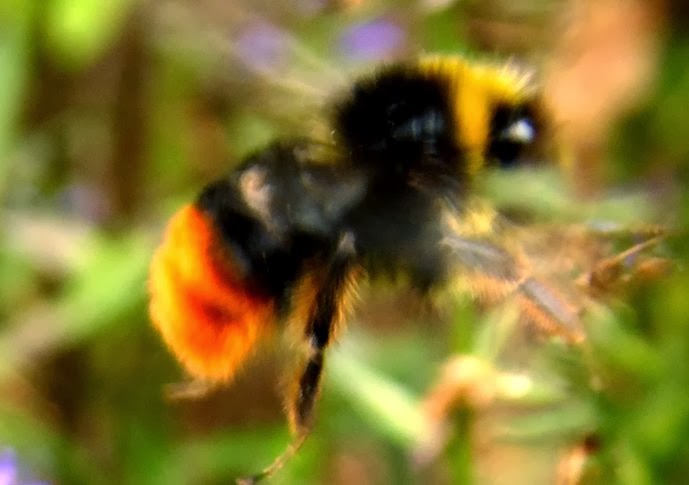
  [...Above ; Of the most enchanting looking-spec, ...The yellow frontside and red-orange from rear. Only seems fly on a few weeks during the warmest season, though. ]

'We take a look around.' (...or, what I've learned about bees myself.) ; ...Mentioning bumble-bee(s), then reminds me about how much I just happened to enjoy watching the bumble-bees at their natural environment during previous summer. (Most species at pics probably were photographed at my own backyard, but then also there's many pictured on nearby semi-natural forests, also parks and orchards, ao. Actually, very few of these I saw at any wilderness areas (ie on any actual forested landscape). Quite clearly they're not anyhow scarcer there, but appear perhaps less often noticed than from the'semi-open'. ; ...Bumble-bees are also most easiest recognizable group from hymenoptera at these Northern soils. During some warm summer day are very observable almost anyplace where's some vegetation. (Means also that at the Fennoscandian latitudes, bumble-bees are the best adapted species among bees for cold spell – Actually there's not the usual (wild) honey-bees in the Natures here. Of course there's many various groups from solitary bees. But all from the honey-bees are maintained at nests kept on human purposes.) Perhaps interesting also that at Northern temperate zone hymenoptera also contains largest amount singular species from any insect groups, indiffering from how that is that on warmer latitudes.

...So, not any wonder majority of pics alongside are from bumble-bees. More widescale asssortment about variety hymenopteran families would've of course been more informative (...various genera and tribes. Any of the singular spec. here, also could've been easily identified, but didn't have time for that...see of the precise genera by yourself, if you have...it's not likely even too difficult nowadays with modern internet and the intelligent search-engines provided.)

  [...On the left ; Also a bumble-bee, on some Toadflaxes...]

...To me these lovely creatures however have far more importance than any of pics could superficially represent; Meaning both (their) emotional and affectionate importance. Fx, I remember very lively circumstances from each of these. I mean, how was the particular atmospheric conditions/climate on that particular time from the day any picture was taken. The weather (mostly these were flying during sunshine, of course), and what the particular season/time from year it was. And likewise of the surrounding environments – the plants especially; Was it a grassland/heathland/rocky hillsides/messy wild growth vegetation on the roadside, fx, etc. Luckily we have these modern cameras that make so marvelous pictures, it helps to observe and to recollect such enchanting memoirs, easily and nicely.

Watching these species at previous summer, I (personally) also learnt to know them better. By learning to know them better - not just from photographing, but observing - I think, I've also learnt to understand them better. Not just from that they're very benefial concerning my gardening/farming tasks, from pollinating many plants at garden and annihilating numerous pest species (...ao other their prey items). But, I also learnt understand that them to behave just due because their own very natures. ...Some of the species I was able watch just for a brief moments; The bee having sipped nectar from some flower fx, then subsequently flying away just as quickly as it had appeared. Some I watched staying on more long-term stay at certain flower(s). ; And, fx I remember, very lively, the loud buzzing of the bumble-bees on a springtime morning at the blooming willows I was watching. Even knowing they have no sting - unlike the wasps et some other social bees - are completely harmless, that felt quite thrilling. Nevertheless I also was able catch a very vivid impression; That them are, like all the hymenoptera, of their very nature born to some furious breed. ; ...And there were of course multitude of similar enchanting experiences, some rather usual and common-place, but also many interesting and lively.


 [...On the left ; Typical forest wasp ('yellow-jacket'). ...There's actually several quite resembling-looking genera. Most fennoscandian species are perhaps (relative) "tame", when compared for their many tropical cousins. - Some of the species nest at ground-burrows and don't seem much pay attention for nearby-walking, acc. my noticing. (...However, the better known that make those circular waxed nests do and don't tolerate the observer from too close the nest....) ; But, on a forest walk this creature happened land close by for wooden log. Of politely, I then took this photo...from some respectfull distance, of course. ]
 
So, in brief: Them were here before us (humans), and even by noticing all these ecological caveats by our own making – it's more than likely that them will be here (on Earth) even after our time will be over (...with the uttermost propability. Nothing in this world is 100 per cent sure. From the projected future even less can be stated w. some certainty, of course.) Call this attitude (of mine) some nature-romantism if wish, but to me it's just some simple realism. Unlike us (humans) who do greatly benefit from them, the insects don't actually need us in any manner. As the natural logic easily consolidates, or due from a natural order of things, they're actually in every level more self-sustaining...if compared to our human cultures. (We're actually dependent from the insects on most various tasks, not solely meaning the pollinating of plants them handle.). The insects also have, fx, during vast continuum of times, their assumed well over 200 million years of past existence, survived every previous mass-extinction event - w. no particular difficulties or only 'minor hits taken' (...like was the expression by Dawkins we've sometime earlier referred for).

...Otherways, wasn't actually meaning say too much on this. My original idea was only for accompanying these pics w. a few suitable quates from some classics (At the following, see...) I'm also not quite too well acquainted from and about hymenoptera to describe the species esp. But their interesting, and many species are relative easy observe at Natures.
----

'What the ancients said.' ; So here's then lastly few important symbolical references to the bees at the old fiction/literature, which I was able to find. Mostly insects (those 'bugs') are quite devoid of mention in the old books. Yet, there's also plenty important exceptions.

[...Below ; Thistle-flower - Also, are some of the plants that the bumble-bees, ao, most eagerly visit.]

; ...The first brief quote w. a classic w. bee-reference is from the 17th century – Precisely, it's from Jonathan Swift's (1670-1740) renown satire text (or comment it was, for at the time heated dispute concerning ancient and modern learning.) This is also renown due from it's said, by earliest, having introduced the (very famous) phrase sweetness and light, to the English language.

(...from) A Full and True account of the Battle fought last Friday between the Ancient and Modern Books in Saint James's library ; (p. y. 1697, ...the bee-reference is on paragraph:) 
 
...As for us, the Ancients, we content with the bee, to pretend to nothing of our own beyond our wings and our voice: that is to say, our flights and our language. For the rest, whatever we have got has been by infinite labour and search, and ranging through every corner of nature; the difference is, that, instead of dirt and poison, we have rather chosen to till our hives, with honey and wax; thus furnishing mankind with the two noblest of things, which are sweetness and light.”

(...You may have noticed that along w. other words, wax I've emphasized of the text. It is worth the remark, due because from prior there was any electric lights - actually even before the oil-lamps had been taken on uses (or, similar inventions), the beewax collected from bee hives was considered even more valuable than the sweet honey. And indeed, even nowadays it's fun occasionally use some - particularly on this dark season of the year (Nov.). Most enchanting luxury, w. mild light and their sweet gentle scent. ..Although, candle burns out lot sooner than the regular candles. (Of Webster's I also was able find this reference about wax candles cultural past importance: [a Standard candle was] 'a unit of luminous intensity equal to the luminous intensity of a wax candle of standard specifictions, [that was] ...used prior to 1909.')

; Then (almost as famous) second quote...It's from how Rousseau (Jean-Jacques, 1712-1778) on his Les Confessions (1782) described his 'another little family at the end of the garden', ie: 
 
; these were several hives of bees, which I never failed to visit once a day, and was frequently accompanied by Madame de Warens. … At first curiosity made me indiscreet, and they stung me several times, but afterwards, we were so well acquainted, them let me approach as near as would, they never molested me, though the hives were full and the bees ready to swarm. At these times I have been surrounded, having them on my hands and face without apprehendin any danger.”
 
...Rousseau, that great nature-romantic, even finds his business w. bee-hives a source for inspirations/or thoughts most of us could allow only toward the 'fellow' mammalians , as he states soon after at successive sentences: 
 
All animals are distrustful of man, and with reason, but when once assured he does not mean to injure them, their confidence becomes so great that he must be worse than barbarian who abuses it.”

(Although, on the latter reference Rousseau doesn't specifically refer to honey-bees, or neither for the other insects.) ...I can't say him to over-romanticing the human-animal relation on that. While it maybe little too imaginous or speculative from considering insects to possess anything similar or comparable for emotions (/compassion), at least we humans do have those feelings...which also defines our own specific relations towards any animal, even these 'little flyin bugs'. Besides, insect do get accustomed to the particular human personnels, fx the honeybees towards bee-keeper. Even the wild species recognize and react for the presence of the observer...albeit them are usually too busy on their tasks for t0 pay much attention for humans. Mostly - unlike our relation towards them – them actually consider us unimportant, meaningles from their view-point.
 
 [...Beside ; ...an interesting looking spec. - But was speeding through some low hays, so I hadn't chance for any better pic of it...]


; However, my own favorite among these classic quotes (perhaps because it doesn't esp. refer for the honey-bee, but the bees more generally), is from Mary Shelley's (1797-1851) novel The Last Man (1826): 

The chasm, deep black and hoary, swept from the summit to the base, in the fissures of the rock, myrtle underwood grew and wild thyme, the flood of many nations of bees, enormous crags protruded into the cleft, some beetling over, other rising perpendicularly from it.”

...Quote/novel likely reflects the political situations of that time (The Greek revolution and it's independencing from the Ottoman rule, and, likely that bee-reference mostly could/should interpret as the symbolical reference for united support to the rebellion (imagined, actually there wasn't any mutual support) from the west European nations.) 
 
...But my actual interest was merely on origins of that word, or term. (Of course, It's just a few words on that paragraph, used in passing, yet not probably meant without a particular meaning. And even that I don't think those words - 'nations of bees' - even would be by her own inventions, by earliest. ,...or, possibly?). ;...Seems it, anyway, also mentioned (on Benjamin – McCallum, fx) that the bee, (ie, or esp. honey-bee) was been traditionally and often, on many past times and countries, used as the symbol for strenuous moral of the citizens, their industriousness, etc. In brief, all those characteristics that people often find for admirable qualities and would've like to identify to themselves, via the bee. (That most useful domesticated animal 'partner' since long in the human pasts.) So, in a sense, the above quoted sentence also takes this old metaphor – ages old – and turns it's meaning around by recognizing that actually the bees are just as numerous than those nations whose fates and dead-ends the novel eventually is from and about (By the way, quote situates also on the earliest climax in the plot of novel, for it's used at the first melodramatic 'height-point'.) . Somehow very enchanting, even that it's just a few words.

[...To the left ; ...At clover, dark-coloured spec. that seems preferably fly around the early hours from evening. It's maybe, a Cuckoo bumble-bee, ...I'd guess. ]

; ...But of course there must be lots and numerous more references to the bees (/honey bees) on the old literature. Even since from the antique times at least, them've always been favored subject of observation and sources for imagination for humans. The few exerts I just picked here of the texts I was familiar with, and from recent memoir... 
Also seems that this sequel now should end our writings about the Fennoscandian insects (...at least from any groups or genera specifically.) [; G.U.J.]

---------

'Sources' :  (...Or, merely just few some books of the bees)

Buchmann – Nabham, The forgotten pollinators (1996)
Benjamin – McCallum. The world without bees (2000s).
Crosby; Ecological Imperialism. The Biological Expansion of Europe 900-1900 (1986)
- Crosby's classic book is quite old by now and isn't about bees mainly or mostly...but it describes well the spreading of honey-bees along with European colonization to other continents.    [Ops! ...Accidentally that priorly pesented Crosby's earlier 1972 book, but now it's corrected.] 

---------

( The latest posts! - @ Mulskinner Blog @ )


----------
Powered by
ScribeFire.