
The Frogs Have More Fun...

Flowers


"All the names I know from nurse:
Gardener's garters, Shepherd's purse,
Bachelor's buttons, Lady's smock,
And the Lady Hollyhock.

Fairy places, Fairy things,
Fairy woods where the wild bee wings,
Tiny trees for tiny dames.
- These must all be Fairy names !"

(from Child's Garden of Verses
by R.L. Stevenson)


"Anyone can write a short-story.
A bad one, I mean."

(R.L. Stevenson)
----------------

"Science without conscience is the Soul's perdition."
- Francois Rabelais, Pantagruel
- Acc to/above is citated from: Medical Apartheid. The dark history of Medical Experimentation on Black Americans from Colonial Times to the Present, by Harriet A. Washington (Doubleday ; 2006 ; p. 1.)

----------------
"In the high society of the first half of the century, marriage, despite it's bestowal status upon the wife, was the most absurdity. Marriage, conferring instanteous rank or money, ... lost most of its prestige and moment right after the wedding. ...By the end of the century, spurred by Rousseau's moralistic Nouvelle Hèloíse, a contrary cult, that of virtue, arose. After 1770 conjugal and maternal love became not merely admissible, but, for some, moral imperatives. ...

[...]
...Rousseau, who sought for himself the crown of morality in ostensibly defending marriage, presents in his Nouvelle Hèloíse the most enticing and extended defense of illicit love ever penned. The root of the problem is that as the century progressed sensibility became confused with morality: passionate feeling, if expressed in a highly civilized mode with grace and nuance, makes us forgive the Rousseau of The Confessions, for example, his pettiness, his jealousies, his betrayals. This moral-amoral byplay, present already in the novels of Richardson, was to be more intense as the century unfolded."
-
Madelyn Gutwirth : Madame De Staèl, Novelist. The emergence of the Artist as Woman (10,15.)

;
"...As the social contract seems tame in comparison with war, so fucking and sucking come to seem merely nice, and therefore unexciting. ... To be 'nice', as to be civilized, means being alienated from this savage experience - which is entirely staged. [...] The rituals of domination and enslavement being more and more practiced, the art that is more and more devoted to rendering their themes, are perhaps only a logical extension of an affluent society's tendency to turn every part of people's lives into a taste, a choice; to invite them to regard their very lives as a (life) style." - Susan Sontag , on 'Fascinating Fascism' (-74; p 103;104-5 at Under the sign of Saturn)
; "Anyone who cannot give an account to oneself of the past three thousand years remains in darkness, without experience, living from day to day." (Goethe) - as cited by Sontag (on same compile; p. 137.)

;
"It is widely accepted that we are now living in the 'Anthropocene', a new geological epoch in which the Earth's ecosystems and climate are being fundamentally altered by the activities of humans. I loathe the term, but I can't deny that it's appropriate."
; (Goulson), Silent Earth : Averting the Insect Apocalypse (2021; p 47.)
;
"It is sometimes said that humanity is at war with nature, but the word 'war' implies a two-way conflict. Our chemical onslaught on nature is more akin to genocide. It is small wonder that our wildlife is in decline."
; (Goulson, 2021 ; 118.)
;
----------------
"If we believe absurdities, we shall commit atrocities." (Voltaire)
- Citated from; (Joy, Melanie), Why We Love Dogs, Eat Pigs and Wear Cows : An Introduction to Carnism(2010; p. 95.)
;

"In the presence of the monster, you have eyes and ears for nothing else."
; (Flora Tristan) : London Journal of Flora Tristan: the Aristocracy and the Working Class of England ; 1842-edit. (tr: 1982. ; p. 71.)

;
"Every minority invokes justice, and justice is liberty.
A party can be judged of only by the doctrine which
it professes when it is the strongest."
Mdme de Staêl
(on) 'Consideration sur le Révolution de la Francaise' [1818]


10/26/11

Of the trees, plants and insects...

 
Seems that this sequel on our serie from the insect (and plant) enlarged for such many paragraphs,  it's sensible devote this post completely for it. Other topics on separate stories, with more available space, etc. In combined, we have this time three species;  Tree, plant and the insect. Them go nicely together. (But the aim is not represent so many at each chapter.)

Pinus Sylvestris
(Example from a typical
young-growth tree)
 [Scot's Pine]
...Appears difficult (but not completely impossible), to think any other tree that would make such characteristic part of Fennoscandian landscapes than Pine, Pinus sylvestris (or; the Scot's Pine, a reader can notice the English naming manner also of this example...). It is not just from reason this (sole) species of the pines making almost half from all the Fennoscandian woodlands, currently. As well culturally the ('Scot's') Pine from many ways has always been tied in the history of people at N.Europes.


The P.Sylvestris can typically live for 250 years at the most (But in certain cases even double that time. And typically grows even slower and longer in the colder climate at Lapplands). Due that Pine is a species that tolerates largest variety from different environment, it is the commonest tree on Fennoscandia. Grows as well on places with relative much moisture and, more typically on forest heathlands. Equally common on higher elevations/hillsides. The only main prerequisitive to Pine is the adequate amount from sunlight.

 It can persist on such various environments so well because it's roots reach for wide-ranging area in the ground. Pine also forms symbiotic relations - called mycorrhiza - with the large number from fungi. Generally their species you can find to see from forest floor-level. Although, there's also variety other forms of; All fungi have larger rootgrowths below the surface (More precisely view of the preceding link, fx). Association of the Pine's roots with fungus permits the tree better having inevitable nutrients and water of the soil.

Pine always has been favored on human uses and on the modern forestry because it grows to a direct upward trunk. Makes it also practical on most tasks that require wood material. Pine grows almost as long as the Spruce (Picea abies), and little faster, so it is often considered more usable and flexible saw-wood material. However, in the different places Pines can as well grow for quite different kind; Beside the clifftops or on otherways rocky hillsides(fx), the trees are often smaller and appear from more various shapes, trunk turning to more varying forms. Also at different conditions from soil, fx on wet marshland, full-grown Pines sometimes seem surprisingly small, can be just little over meter in lenght.


People also often like walking on Pine forests because it's easy to see for longer distance there. Typically drier heaths where the ground mainly grows fx berries (blueberry, lingonberry), with similar smaller plants/shrubs. The air on the pinewoods is also said very healthy, which is from that the tree secrecates chemial particles that have the effect from killing  bacteria. Due the same reason it's needles, resin and various other parts from Pine have been manufactured at medicinal uses since the early prehistorical time. (Are still in similar uses today, by some part).


Doesn't, necessary, make me too impressed from modern cultivated Pine woods. The (modern) Fennoscandian forests often shows itself as a maintained landscape - At worst planted woods of the stricktly ordered form. ...So it's also easy imagine how much of the natural variety of the landscape actually has disappeared. As the trees nowadays are often maintained to economic purposes, and often the harvesting interval is about 60-80 years (at most), the resulted ecology (on a large part from) Pine forests is far from the natural. Typically continuous harvesting leaves it's traces on forest ground which are just boring to watch. Leftover twigs and cut remainders of the trees drying out in the piles can make walking at places unpleasant (...Albeit shallow plants relative soon grow even from under those). Those marks, of course, are temporary; In some places the faster growing trees coppices can cover those in a matter of some years, at the best circumstances - And, until the area is again cleaned/reshaped with machinery and man).


Already on the past centuries of a more 'traditional forest uses', Pine was very favored tree in the human purposes. In during the 19th century, trade from it's tar made the most important product at N.European market. The tar could be extracted by burning resinuous trunks and stomps of the Pine on large pit. Practice, clearing woods for it's manufacture, is said often been even more destructive to the forest ecology than the modern uses - As there also was at the time more of the actual natural forests left. Tar was so much in demand as the undersides from Ocean-going vessels (and regular boats) were frequently needed layered with tar to keep them on sailing condition. (Among it's other uses, various wooden tools were covered with tar to make them resistent for moisture. Most went for the export, of course.) Seems said that effects on forests used from that (making of tar) are still seen on regions. Closer some coastal areas the older Pine forests largerly disappeared prior the 20th century and then became replaced by the younger growths of Spruce.


More overally, nowadays it's not the scarcity or disappearance that probably would at first sight catch the view of any casual observer of the Pinewoods. Even today quite much of the natural (Fennoscandian) woodland ecology exists, although it is been converted and changed on most places, sometimes more severely (think about the drainaged marshland, and/or those planted and heavily harvested forestries. Both are mentioned on this instance since any human brought influences have the capability affect to environments on a longer momentum - And any conversion of environments/natural recovery seems appear a process from the decades scale, at least. Often  centuries.) 

On a walk you can also fx wonder and look around on a seemingly very natural looking woodland, growing some (quite) large trees. Then you glance for a place to rest a while and notice the old stomps, almost decayed and covered by the moss now. If you look closer as well other old marks from the human efforts may show, and a more trained eye soon, probably would recover lots more, older 'tracks' from similar kind. (Newer marks and tracks of course appear more apparent and visible.)


Forest cultivation (history) on Fennoscandias often deserves it's best mention from that the nonendemic (*) tree species were never planted - justifiedly so, as on many places that's said brought the most harms, seen causing fx  the impoverishment on  soils, increases of erosion,  ao similar ecological harms.
Yet, something very clearly is missing. Not necessarily the animals (fx, insects on a suitable season sometimes appear as plentiful as latitudes can permit, and  larger species aren't that expectable to so often show themselves - except from the birds).  It is not even of the plants (certainly diminished, some appearing more limited ranges, but still showing quite various kinds). Perhaps not solely even from those forest roads been built almost everywhere on S.Fennoscandias. - More likely it's from the all above discussed aspects; Smthg having to do with the declines of  randomness and of ecological diversity.

(Perhaps apparent also that),  I've never even much preferred the tree in question. That actually originates not from any logical reason for and in spite of all those respectable characteristics of it: Pine certainly has  lot of ecological importance, it has been of great importance culturally, economically was earlier as much a source of richness as it is today (once also made an important source for foods at times of scarcity). Yet, personally, and as long as I can remember, I've always disliked it. Too much of anything has the effect from bringing alongside a scarcity of something else, more or less so also on this case...


[Heather] ...As this sequel represents even two plant species, here's also few words from Heather (Calluna vulgaris). It's a common subshrub plant, recognized by most people of it's colourful Autumn blooming. Seems it said from relative early having benefited from human impacts on Natures (the West European heaths actually are said mostly formed as followings to the clear cutting of former woodlands). On Autumn the cultivated species from Heathers are commonly at sales on garden shops. From this forest plant the 'Natural Apotheket' even mentions it's flowerings being usable for making some relaxing Tea (Not all species from heathers proper to use for, and only the petals from flowers, not the other parts).

Heather makes important source of nectar to many insects. Bumble-bees (and alike) frequently visit, although interestingly it's said the smaller insects actually taking care of the plants pollination. Typically pioneering species, it commonly grows on European pinewoods/open heath. Similarly like the Pine, is also quite demanding from light. A colourful ground-mats of the heather, on Autumn, can best be seen either on the older forests, or at very recently cleared areas. ...Seems said it is mainly tolerant of forests younger than 20 or older to 70 years – because of the need from much sunlight). Maybe that also is reason for that - little surprisingly - Heather is mentioned to have generally lost of the total area of growth on Fennoscandia during past 50 years. That's because, at least partially, from the forests are more densely growing the trees, nowadays.

Still amongst some from commonest plants at forests, Heather also has the capability of growing on quite various lands (usually on drier grounds, but also fx on more moisturic places like marshes). It also relative effectively can gain new places of growth. Seems it even mentioned capable - for a limited period of time - from slowing down the growth of smaller trees. Heather can therefore persist somewhat longer on places where growth of the trees otherways would soon deprive it from it's needed light. But in time fx typical berries and other more shadowy tolerant plant then start replace it.
 [No pics from, because the plant appears quite difficult photograph, acc. my experiments...]


[Cerceris arenaria] ...Quite several paragraphs were devoted to those most representative forests plants, so this now leaves us just little space for the insect example. Like was promised before, it's a hymenopteran this time (Quite a justified selection, as those all in all make the largest group from the Fennoscandian insects.) In addition to the commonest (better known) social bees, there's multitudes from solitary species, although most are not so often seen. Predative species make a respectable amount from them, containing fx  the Spider Wasps (the name derives from their habit for catching and paralyzing spiders) . The prey is  drag for the nesting hole, and  the emerging offspring later  feeds on that. Also, there's fx the Field digger wasp (Mellinus arvensis), that catches flies. And the European Beewolf, which - like  the related genera on it's genus - specializes on various bees (...To name a few). Most predative  hymenopteran belong to the Vespoidea, ie they are related genera for social wasps.


The species discussed on beside paragraphs... 

If my guess is correct – although, like said there's lots quite similar looking species – this exemplary species (in the pic) would be Cerceris arenaria (Although, I wasn't finding any English name for it). In that case, would represent example of a species specialized on catching Snout beetles (Curculionidae). Adult is mentioned to prey an amount of those, the larvae then later emerging feeds on them. Adults however - like the other solitary hymenopteran usually - are said feed on the pollen from flowering plants. (I guess) it's not quite unlike encountering the species at the open Pine forest, although at a place I noticed it was bushes beside small road, mostly a sunnier area growing forest flowers and various larger vegetation. Perhaps it's more expectable area to seek these species, often (on such places) there's also places where solitary hymenopteran typically can make their nesting.


Like most from Vespoidea, it seems quite slenderly built. Also has little similar looking yellow stripings. Lot smaller species than the common social wasps, though. (....Whatever this species exactly, like said, could quite as well represent some other predative hymenopteran. If you know from it's precise identification, can offer me that...).


(W-G.)

 * ...However, because endemic, strictly speaking, is mentioned a term referring for species which appear just on (certain) eco-region (/or, particular environments) and nowhere else, it is noted that a more proper word to use at this would be the introduced tree species that not appear on forests/natural environments by origin, prior the human impacts...
 -------
( The latest posts! - @ Mulskinner Blog @ )


----------
Powered by ScribeFire.


9/29/11

Comparison from (some) Sweeteners...


For a change, this makes brief comparison between some natural sweeteners. The idea of it, of course, originated from nowadays rather usually discussed aspect; Human agriculture often favors a limited number from plant. Typically described as creation of monocultures (at least environmentally speaking/biologist often use the word). One doesn't have to look too far, but fx some from most commonly cultivated plants, fx wheat (w. some other favored cereal), rice, sugarbeet/-cane, soya, coffee, etc. (From more recent timing also often there's mention of various sources to biofuels, (fx) maize, palm oils, etc.) ...Of course, this is a selective list, to which quite a few other plant could be added.)


Maybe worth noticing also that sugar grown in the MSW appears cultivated from the domestic sugarbeets, while some from alternatives 'offered' here are imports. Ecologically makes therefore not that much of a difference...But, on the other hand, many from mentioned as well are lot healthier alternatives.

So, we're here mainly comparing some alternatives for (/from) the sugars. Energy and carbohydrates listed on basis of information from product packages - So that likely differs a little between different products manufactured of the same sweetener (Regular sugar seems said to contain 1700 Kj / 400 ckal and 100 g Carbohydrates [Cbhr] on 100 gram) ;

Honey
(what else; ...it contains): 1400 kj/335 kcal energy /Cbhr: 82 g)

Honey, of course, is recommended from it's many healthy qualities. As the insects make it, it's a natural product indeed (Actually, I don't even consider bees completely domesticated animals for they spend large part of their tasks away from the human kept nest). Also, I'm not so convinced from the bee-keeping being that environmentally benefiting than sometimes adverted, because bees often are maintained for pollinating certain plants in cultivation. Depends completely from the scale of it, of course...And, bees do appear important pollination agents in Nature.

There's various different labels from honey; Products may differ fx from what the main source plant of bees, whether the product is imported or is it homegrown, etc - Seems fx mentioned that some made by the bees visiting flowerings of the Lime (Tilia) has always been very appreciated among nest-keepers...Bees also are kept very widely cultivated around most everyplace and there's variety from spiced honey as well.
So, for sweetener it serves well and I often tend use honey on teas, fx. Less suitable to some other foodstuff, perhaps, but I guess I'd probably use honey anyway just because of it being so healthy.

Agave-Syrup
(1249 kj/298 kcal; Cbhr: 77 g)

...To the contrary, isn't been on commercial manufactures very long (apparently). Squeezed (apparently?) from cactus (/and related plants?). I find this quite tasty too and makes even lighter alternative as a sweetener on various uses. Taste might need a little getting used to.  Fair trade product and sold in liquid form. And, it's not bad at all either; As the only negative aspect I find, appears that packaging is on plastic bottles (Although, that feels quite practically manufactured so it can have some other uses after been emptied...)

Maple-Syrup
(1140 kj/270 kcal; Cbhr: 67 g - Only 62 actual sugar)

...Likewise this also is advertised among healthiest from natural sugars. Made of the sap from (Canadian) Sugar Maples, Acer Saccharum, (which contains 5-7 per cent sugar).

Seems as well that around the 19th century when most sugar was made from Sugarcane, sugar prices peaked and also sap from European maples (Norwegian maple, A. Platanoides, which contains 3-4 per cent sugar) was commonly manufactured. Noticeably, it was during imperialistic era and the trade market, when most sugar to Europe was at the time imported from colonies. After the sugarbeet farming gained ground, probably more commonly around the end of 19th century, also production from the sugar maples declined. [Acc. The book History of Foods (2003) the cane- and beet-sugars becoming  the dominant sweeteners in the World, particularly the production from sugarbeet, is quite recent phenomenom - For an interested there seems be somewhat lengthier paragraphs from this subject on that book; Of the history of sugar-making, development of it's techniques and the trade throughout the modern times, See (from) the online version of it].

...Even that the Maples syrup appears often recommended w. pancakes and similar, I find that not any particular favorite dessert of mine. But well, so tasty with the ice cream every once in a while...

Fructose
(1692 kj/398 kcal; Cbhr: 100 g)

The amounts from energy and carbohydrates in Fructose seem almost the same as from usual sugar. Also taste is generally quite similar. Main difference is that one needs add that only about 1/3 less (Fructose is actually somewhat sweeter from taste). Other meaningful aspect is that it's as well healhier in comparison to regular sugar (Yet, seems it sometimes advised that one shouldn't consume but a limited amount from Fructose at daily uses...); Comes on a solid form (granulated sugar), so can be used quite easily.

Birch-sugar
(1000 kj/240 kcal; Cbhr: 100 g)

...This locally manufacured variable(/product) is also sold on granulated form. This too is manufactured of a tree, from Birch (Betula pendula). Doesn't taste much like sugar, actually hasn't the same sweetness at all. But, as well mentioned 100 per cent Xylitol, and therefore not negatively affects the teeth ...Which is, in fact, quite meaningful aspect. So I'd probably favor this too, at least every once in a while.


There could've been some other manufactured alternatives, very probably (Also fx variety from different products manufactured of the sugarcanes). - But, due that this was mainly to recommend some alternatives from sugars, seems it also sometimes advertised the Coconut Sugar (it's not the same product as the sugar palm, however) from some of it's benefits from manufactures (and the healtniness on uses), especially due that (it's said) lot lesser water uses needed  on it's manufactures (than on cane sugar production) ...However, I've not more especially checked of it, or had that product available/tested on this comparison from natural sweeteners, so just said in passing...

But, summa summarum, conclusively I find I can probably have a place for any of these, there's some proper usages for each of them - Birch-sugar and syrups mostly would go w. tea, rarer on baking; Honey has many uses, also on desserts (sometimes); And fructose simply is similar of use as the sugar, it also is a bit cheaper than most from these...).
(...And, additionally feels to me also of some importance remark that I actually consider sugars necessary for the uses of human body, etc. - Ever if exercising any physically demanding 'sports' it is of proper need, fx. The bestway to gain the lost energy would probably be eating some sugarine fruit(s), but often bar of cholocate or other sweets does the purpose adequate well; at least acc. my experience from (Unless not eating those too regularly, of course - I'll let you choose the amount yourself...:) Like often is talked from, people in the developed world generally use too much sugar, and the similar expected to take place on most countries with raising levels of living standard...) ...Like it was earlier remarked they're (,ie these 'natural sugars', not the chocolate bars or sweets) also somewhat healthier alternatives to sugar. So, in the end of it, we just notice that common wisdom 'Variety is the spice in life'. (W -G.)

-------


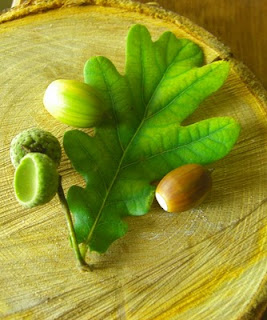
Oak; The leaf and a few acorn.
(Acorns were gathered for food on prehistoric times.)

...Because it's now an occasional custom representing these examplaries from Fennoscandian nature in pairs (ie some plant and insect species at the same), we have a few here. For the main part of this was devoted to sweeteners, would've perhaps been more suitable select fx (Norwegian) Maples (Acer platanoides) for this too....But I guess the Zeus won't mind too much if these paragraphs are from the (English) Oak (Quercus robur) instead; (Also, little funnily, seems it being that the English common names for some trees are based on country names, in spite of that both of these tree, fx, are found pretty common from grow on much larger regions of Europes)
...Anyway, Oak(s) are trees at a family of beeches (Facaceae), and on mid-Europe grows numerous species, but only this singular one (Q.Robur) is said originally to grow on Fennoscandia. As for some of their qualities/characteristics the Oaks - in particular the Sessile Oak (Q.petraea) and Q.Robur - fx are mentioned rather resistent to moisture and so they've lot been used on construction works since long-time past. In the former days it was so popular on ship-building of the reason that wood from Oak only becomes stronger and more compact when kept in contact with water.


Even (much) further on times at the pasts - after latest Ice ages - seems the Downy Oak, Q. Pubescens, actually been a tree that consisted the largest part on forests at Central Europes. Later, with the slight warmer climates, Beech (Fagus sylvatica) seems much gained on it's places. Like also renown, Oaks have always been very appreciated trees; Not only by the ancient Greeks, but (ao) Teutonic (German) tribes and Celts associated it for their highest deities. Also has enjoyed appreciated status in Christian religious means.….Culturally one can also think from that often imaginative, little horrifying picture from a (very) old tree - on popular literatures, comics and cartoons, fx. Unless that (image) isn't borrowed from the looks of an old Spruce, or Yew, it most often appears drawn resembling the old Oak.


From it's current overall range the English Oak seems cover most of the Central and S. Europes. However, and like often typical for human uses of the nature, trees positive 'status' wasn't in the past enough from preventing it's overuses. In fact, seems that at many places - at the world and Europe - the human history also tells from an exhaustive uses of the Oak(-forests). Fennoscandia is no exception, although Oak grows there on it's ecological Northest edges. (Pretty) much like elsewhere best part from the original (natural) Oak-forests were exploited already during  the 17th/18th centuries. (...Although, the past use of Oak/changes on landscape during the centuries may have been somewhat more limited than on many places, largely due the above said reason. And, also from reason that human settlement appears lot younger than on most parts of Europe; Earliest traces from human agricultures at Fennoscandias are said date back to only about 3000 years - So, the trees actual natural extent, preceding that human brought alteration from landscapes, is maybe little difficult from estimating precisely.)

Whatever the  timing, or scale that migh have proceded,  larger parts was converted to sowing fields (Groves and other places where Oaks would grow often made best fertile lands), and some as well went to construction purposes. Not much surprisingly lots also was used to the ship-building, as the Sails were the main armament of the emerging countries with coastal line on Baltic sea (ie that was about 17th century onwards). Because of the growing need for material to this - and from somewhat lesser extent to other purposes - still as late as the early 19th century it was planted cultivated Oak-forests on parts of Scandinavia (by the Crown). ...Wich wasn't ever adequate for halting the demand from exceeding  the supply. Yet, some of those planted forests still survive and are said become somewhat aged by now.


In brief it makes quite typical an example from human exhaustive uses of the 'resource'. (However, originating from those planted forests, as well from the Oak been commonly planted on roadsides, parks and gardens, it is said that singular trees/small patches now grow on a more Northern range than the tree naturally would appear.) Conclusively maybe is also worth noting that Oak wasn't a sole hardwood tree of which the natural forests were extensively consumed on human uses even before the beginnings from our modern era - or, the times of  "so called" economic forestry practices.


Ecologically Oak is said an important tree to many species; In fact no other tree on N. Europes hosts so many insects. It's said that very old trees – Oaks can grow to 1000 years, but on North the average maxim seems closer smthg like 500 – offer living environments to a countless number. Some of those species wouldn't even appear on Fennoscandian Nature otherways (fx, from Finlands regional are 9 species of butterfly/moth seem said from increasing solely on Oak). Acorns of Oak are as well very nutrient rich - They contain 390 kcal per 100 g; And 30-60 per cent starch, 10 per cent sugar. (So them are harvested by several larger animals.)

 ------


Araniella cucurbitina
(Hanging on gossamers between leafs
of the Oak-sapling)
...Likewise than  from the plant selection, of the insects perhaps most proper choice on this would've been some Hymenopteran species (ants, bees, wasps, ao) - as the main part from this was devoted to sugars. But this time it's a Spider (...yes, very stricktly speaking they're not insects, but don't let that be an obstacle...). Spiders appear very numerous from species on most parts of World. For a selection on this, fx the Araneus diadematus (the species renown from it's elaborate web), would've made nice choice. Or, some of the flower-spiders, they're even said capable from changing their color during a few days time, (between yellow and white). Anyway, this example on pic (mostly probably is) Araniella cucurbitina ('Green Cucumber Spider')...Selected since it's said  commonly appearing on forested regions, and mentioned found on places (ao?) where there grows some Oak. Bright from colour and quite symmetrical by look (Perhaps little horrifying too...)
...And it was there by purpose: After mating the female is said rolling its eggs (offpsring) within the leafs and remaining on guard there. ; Similarly like the Oaks, spiders easily exceed human time-scales, before there was most of the now present organisms(/animals), there already were the spiders... (G.U.J.)


9/11/11

Cooking companion, pt. XIV


From original intention this sequel was to contain various foods that can be prepared from the 'Natures offerings'. Means in this case that I considered it to consist recipes from (smth like) berries, salads, mushroom, etc, a stuff possible to pick by oneself ...But it then turned out that finding anything suitable maybe needs a bit more experience than I probably find myself mastering. Also, for comparison, the cultivated plants often are more easy prepare – after all, they were taken on cultivation and bred by the people in the pasts from plenty of reason, not the least that many are good and tasty. And, soforth this provides recipes from a favored plant, namely beetroot. ...Has nice English name besides, that a lot resembles this populous insects order (meaning the Beetles.)


Anyway, beside beets,  Rowan also has place on this,
So here's nice late Summer pic from the Tree and it's Berries...
We've probably already prepared several recipes from beetroot, so here's just some simple varieties, only. Root is most commonly known, but there's a place in the kitchen for other parts as well. First a recipe for salad, this is pretty good acc. my judging;

Mixed salad

Ingredients; Beetroot leafs (a single bunch, about); Any other (preferred) salads; Seeds - at least Sunflower-, Pumpkin-, and perhaps also (fx) cashew-nuts; Some pepper slices; And some slices of cooked eggs /or Feta (crushed). Sauce: Vinegar; Olive oil; citron-pepper; garlic (a few pieces); mustard ...and a little citron-juice poured over ready-made salad.


Recipe: Just mix them in bowl, make a sauce from vinegar, oil and spices. Lastly add egg slices and/or feta.

Sliced fried pieces (in the sauce)

Ingredients; 1-2 beets (sliced); Olive oil; Vinegar; Fresh herbs (I used tarragon, citron-thyme, and whatever else...rosemary?) ; salt; Black pepper (fresh, crushed); Citron juice

...The beets should be sliced rather thin,
although not quite like Capt. shows w. sausage on this picture...

Recipe: Beets are often cooked (unpeeled, to guarantee the vitamins remaining), then offered as appetizer with fx butter. It's quite possible to fry them on pan, also (peeled and sliced for pieces first). They can be soaked in the sauce overnight first. Recipe is actually simple, just mix the ingredients together and pour it over beet-slices (which are placed in a deep plate). Fry them for a time that feels suitable, with sauce they don't burn too easily and (I guess) the proper is about 8-12 minutes...


"Kvass" (from the beets)


Ingredients/Recipe; …. I guess Kvass the name of this, don't know if that even has any term on English... Peels from beetroots (fx about 2 kg, it is mentioned typically prepared of remainders when making pickles (However as I had not that purpose I made a smaller amount of it.) ...But the peels should be carefully washed and cleaned prior the cooking); (about) 5 l water ...After cooking them about 45 minutes remove the peels and pour for water little sugar (if wish); About 1 kg of dark bread (Rye) is sliced to a larger metal kettle and the water poured over that. One can also grate some beet slices to that. That covered with cloth and let be couple days (in warm), occasionally mix it with a juniper twig (or a regular wooden cookery stick, but cause it's a minor trouble I brought actual juniper-stick; that can later be reused on any other cookery). After couple days the drink is bottled on glass-bottles/cans. (Use a thin cloth or smth else to distil the juice from remainder of bread-pieces, etc.) Ready on the next day. Not bad, perhaps little unconventional on these of the ready-made foods in the ready-made world...

...Even me, such a great fan of beetroot, probably has to admit that you can't quite use them on every-day basis, beets also contain quite much nitrate, so recommendation is to prepare them just every once in a while. This last recipe represents alternative selection, it's made purely from the Rowan-berries. (...As an additional mention we can reveal - w. the highest probability, most presumably, very certainly – that this is actual recipe for that 'Devil's Resin Jelly' which Larkie Inez prepares to Scrooge McDuck on 1960s Carl Barks drawn comics story 'The Golden Fleecing', even if being named differently in that serie...) But, believe me it's really tasty, if you happen to prefer the little bitter taste of Rowan-berries, of course. Berries contain also lot C-vitamins so it's quite healthy delicacy as well. Personally, I also have not any difficulty of believing that Robin Hood and his Jolly companions enjoyed this with the deers (and other wild game) they might have harvested from King's forests in their times... (G.U.J.)


Rowan-Berry Marmalade

Ingredients; Rowan-berries (about 1 kg/4 dl water, ...Acc. The original recipe; 'cause I had little shortage from them available, I actually prepared a lot less) ...and about 9 dl sugar for each litre juice made.

Recipe: After picking the berries remove any bad or spoiled and place them in the freezer overnight (unless very late on Spring when they're already frozen). Boil them then in the kettle (covered with lid) for about 20 minutes and occasionally press berries on the sides to squeeze the juices off better. Next let that pour for bowl through the cloth (but don't press the berries this time). After washing the kettle boil the juice at it a little time and in parts add sugars, then boil that again. Only stir very little, and remove any foam that emerges. After it thickened you can pour the result to prewarmed (and desiccated) cans, close them tightly.

-----------

...Unless I'm not completely mistaken,
This is a (female) specimen from Scorpion Flies,
Small species...but how nice patterns/colours.


The place of the (Fennoscandian) insect selection/example at this sequel is from the Mecoptera ie it's a Scorpion fly. Albeit it's mentioned that the Mecoptera are believed quite old group from earliest origin, they seem placed rather close to Diptera (Flies) on their classification at the insect orders. (Feels little odd, since the Flies are usually said being advanced, relative late evolved insects ...But who knows, for I merely consider myself as a layman from this insect biology, not any professionalist, guess there's some sound explanation for that. However, the insect evolutionary history seems goes far in the past, the Diptera being 'lately evolved' only means that they appeared only some (couple) hundreds of million year ago...)


Mecoptera, precisely from their habits and adaptations in Nature may feel a little repellent (from some view-point...) - for they are scanvengers. They take benefit from the dead animals, of any kind; insects, mammalians, ao, can do. Mecoptera also have an elongated snout (not visible on this pic) which they use to digest liquids of carcasses. Further yet, they're even told to steal prey from the spider webs ! ...There's only about half a dozen different Mecopteran species on Finlands Natures, although most appear quite common and are not scarce to encounter. (But globally on those distant pasts, they're said have consisted closer 10 per cent from all of the insects. Nowadays, the Mecoptera only make about less than half a per cent, in total. So they're kind of relics, as was discussed on this. )

...I've also noticed that they usually are encountered from a places of some dense vegetation, fx meadows and small coppices with bushes. The species in the pic has a lovely colours and pattern. (I guess) it's probably commonest of Scorpion flies on Fennoscandia.


8/28/11

The New Power Generation...

; Mulskinner Hi-Tec Review XV ; [ V / 2011 ] :

 Re-chargeable Batteries 
[Gp 2500 & Moixa USBCell 1300 Ni-MH]

It's probably true that every new invention brings along both benefits and (some) negative consequences, even if for the latter usually is given less thought. (Always is also not too clear how those two balance). Of course, any new invention tends at begins be loaded with positive expectations, assumed soon to replace any former technology, etc.


According my memoirs, 'break-through' of the rechargeable batteries - them been adopted in common use - took place about some 10 years ago, mostly within the new 'computech era' and the increase on amounts of hi-tech electronic bought for homes by people. (At least here on MSW; Perhaps the re-chargeables, like inventions sometime do, were taken at someplaces more commonly used even prior the early 2000s.)


The advantages from rechargeable batteries are very obvious: You can reload them innumerable times (producers seem promise about 1000 cycles, but in practice the figure is perhaps more often counted in hundreds... either way, for consumer that anycase appears lot cheaper in the long-run than buying new case of batteries each time). Also, the environmental aspect is indeed significant, the extra waste from batteries is minimized considerably

So ...inspired by the emerging new hi-tech world and the countless adverts from big savings (for me and the Natures) I bought those rechargeables and charger for them around that time. Later, having noticed that there also was batteries reloadable via USB-port (or, if wish to use the charger that goes too, USB-charging is little slower, but permits leaving charger at home when on the move). So I bought some those too. And - I cannot avoid mentioning - that the decision was by no means based on coincidence that the earlier bought some (those reloadable only by charger) happened to resign their contract a lot before than the assumed (about) 100s rechargings. (...After all, that felt so usual in this MSW-world - where nothing ever was been allowed as unproblematic as it in the normal circumstances would - And so I was merely surprised that them weren't been completely forbidden from us because of his Ungracefullness unmercyfull demand...)


...However, it's of course quite as well recognizable that not before the emerging appearance of power-consuming products and devices, Ie before the early 2000s (about), this kind of batteries weren't very popularly at any wider uses. But then there started to appear devices like digicams, game-consoles controllers, etc., ...to name a few.  There had been some re-chargeable batteries on market already prior that, although probably lot less commonly, (and them also were still less durable and less practical earlier.) As often the case, new inventions gain wider acceptance only when they meet the actual need from majority of consumers. Or something like that,  main point at this is that anyone from this can clearly notice a certain similarity on the typical manner on human made inventions and their relation for the environmental questions. (Often) new  inventions - no matter if there's any technical burdens needed solved prior their breakthrough or not - only gain acceptance on markets (and of the consumers) when their shown beneficial for the people, or when the people notice having some use of them by themselves. That's of course quite obvious - would be rather contradictional sell people new devices and advertise them consuming less energies and at the same time to advice people not to use them because of general increases on energy consumption. However, the fact is, that the rechargeable batteries (an environmentally recommendable alternative) probably wouldn't yet still be so commonly acquired and found of uses by peoples unless there weren't nowadays increased amount of techs and devices having use for those.


Whether that's just a part of the truth on this is naturally question open for argumentation; ...But quite much the human energy uses follow similar problematics, and in any case them are tied to a question from how it is hoped most effectively reducing the actual energy-consumption. If one just seeks to find some compensations to the projected increases on energies used (and, to the uses of Natural resources) that not showing any actual answer(s) for the original problem
(Or, so I see that, the comparison in this case maybe is little 'far fetched', or it's not too relevant a case example on this; Re-chargeable batteries are of course more recommendable alternative to non-rechargeable some, simply from reason of reduced waste generated from used batteries.)   (W-G.)


-------
( The latest posts! - @ Mulskinner Blog @ )


----------
Powered by ScribeFire.
7/26/11

The Undesigned Chapter, Part V

;”No passion for fashion”

[Book recommendation 30½]

I say, beware of all enterprises that require new clothes, and not rather a new wearer of clothes. If there is not a new man, how can the new clothes be made to fit? If you have any enterprise before you, try it in your old clothes. All men want, not something to do with, but something to do, or rather something to be. Perhaps we should never procure a new suit, however ragged or dirty the old, until we have so conducted, so enterprised or sailed in some way, that we feel like new men in the old, and that to retain it would be like keeping new wine in old bottles. Our moulting season, like that of the fowls, must be a crisis in our lives. The loon retires to solitary ponds to spend it. Thus also the snake casts its slough, and the caterpillar its wormy coat, by an internal industry and expansion; for clothes are but our outmost cuticle and mortal coil. Otherwise we shall be found sailing under false colors, and be inevitably cashiered at last by our own opinion, as well as that of mankind.


We don garment after garment, as if we grew like exogenous plants by addition without. Our outside and often thin and fanciful clothes are our epidermis, or false skin, which partakes not of our life, and may be stripped off here and there without fatal injury; our thicker garments, constantly worn, are our cellular integument, or cortex; but our shirts are our liber, or true bark, which cannot be removed without girdling and so destroying the man. I believe that all races at some seasons wear something equivalent to the shirt. It is desirable that a man be clad so simply that he can lay his hands on himself in the dark, and that he live in all respects so compactly and preparedly that, if an enemy take the town, he can, like the old philosopher, walk out the gate empty-handed without anxiety. [...]


I cannot believe that our factory system is the best mode by which men may get clothing. The condition of the operatives is becoming every day more like that of the English; and it cannot be wondered at, since, as far as I have heard or observed, the principal object is, not that mankind may be well and honestly clad, but, unquestionably, that corporations may be enriched. In the long run men hit only what they aim at. Therefore, though they should fail immediately, they had better aim at something high."
(From Walden, or Life in the Woods.)

Above words, loaned from the famous book by Henry David Thoreau (1817-1862), serve as a possible, alternative view-point for the wear and purposes of clothing. Todays mass consumption market and existent social systems are of course separated by centuries and decades lenght of years from Thoreau's era. Yet, a very unprejudiced observer easily finds a lot similarity in between, fx from the customs developed for manufacture, wearing and buying of the clothes. 
(For to underline Thoreau's own dislike of his own times popular fashion, his 'observations' even go as far as to comparing for monkeys the keen followers of fashion that say 'Hurrah' and adjoin for any new change of mind by their worshipped style-forming idol. But I'm only presenting his views on this from the reason they seem very sensible and, also, very idealistic attitudes to this aspect, clothing. Considering that a bit more precisely, it's also merely so that most monkees - close relates of humans - actually change their 'natural garment' lot less noticeably than various other species that seasonally do. Birds and frogs, fx.) 


From a very strickt environmentalist point-of-view, (...For Thoreau's Walden is a classic among environmentalist books of the modern times, in fact it's often mentioned as the very first environmentalist writing that ever was published) ...it can be noted that not much any fashionable clothes or the usual house-hold designs succeed meet even any lower ecological criteria or 'standards'. From the same view-point them both – more often than not – represent just an excess production created for to satisfy the excess needs by the people accustomed for their overwhelmingly rich life-styles. 

I also agree with the sentences that it's often better to mend the old clothes (with piece of fabric, fx) than buy new, but I cannot help from also notice that because of the availability of shops and clothes these days the choice by consumer more easily goes for to prefer the latter alternative. In spite of that, and in particular because of that, a choice for organic and controlled manufacture of clothes (fx) is always also an act of opinions-giving. [...Opinions-forming, more correctly the word we meant use at this, I suppose... ; W-G.]  Additionally it could be noted – as the foothold and basis of the most ”regular” clothes production today is on the chemial pollution of waters, low-income jobs (in the developing countries, mostly) and in overall a careless consumption of materials – that choosing not to buy can be at least as important ecological choice. (What said at the preceding sentence, of course, not expressed as any straightforward answer to the problems addressed, but just is an attempt in favour of responsibility on consumer behaviours, etc., ) On the other hand, it's also probably quite as much sensible notice that there's also nowadays great differences between, say, moderate and excessive sums that can be/are spend on the clothes (fx). 

(As a direct following of my own dislike to all that useless spending on fashionalized clothing, also as the expression against manufacture of intentionally made bad consumer stuff, I often wear my sneakers – metaphorically said - to the pieces. ...In other words until the need of constant washing of socks becomes a larger ecological burden. :) 
But, where in the world could a buyer find a usable and durable pair of those shoes these days? (W-G.)

----------

Latticed Moth
The species example on our continuing series from (Fennoscandian) insect for this part is the Latticed Moth (Chiasmia/Semiothisa clathrata). It's a smaller creature from the Geometridae moths, ie belongs for the day-time flying species of moth and most usually is spotted on during the early evening from meadows, haysides, cultural landscape, etc. (...The Geometridae-species also include fx a better known, although controversial, 'case example' on the industrial melanism, Biston betuliaris. The group consists perhaps the 2nd largest group on Lepidopteran species, contains about 21 000 separate species.)


Latticed Moth has a wide appearance accross the Palearctic-ecozone, that - at least by some part - is from the reason it's caterpillars tolerate a range of different feeding plants. They usually feed on Fabaceae, (ie various peas, incl. fx Lathyrys prantensis and Trifolium p.) that also are widespread on larger parts of Europes (ao regions). A smaller species, with wingspan from about 1.8 to 2.8 cm, the Latticed moth is on typical summers found amongst the most common species also on Fennoscandias, flight-time between June-August.


Interestingly, seeing some specimen on the early of Summers (when they are smaller by size) gives a bit different impression of it's looks. That from the reason of those criss-crossing black patterns leaving lesser space for the white areas at it's wings. Either the individuals from 2nd generation (usually flying from mid of July, like the specimen in the picture) grow larger, or slow growth just changes the impression of the earlier flying specimen during summers. 

All in all, represents not any rare or unusual insect although one doesn't so often see them at open areas. ...Also, quite funnily, I notice myself liking the least from so called b/w styled interior decorations but find this little moth an elegant and very stylish species, particularly when it's seen at suitable place w. some contrast of the sunlight and more shadowy areas. (Reassures me at my belief there's nothing much human created which wouldn't already have found a realization in the Nature lot more nicely...)

-------
( The latest posts! - @ Mulskinner Blog @ )


----------
Powered by ScribeFire.